Despite what some of the branches seemed to believe between 2008 and 2015, camouflage in the United States’ military is not meant to be a special uniform for each branch; it serves a purpose. It’s a deception tool meant to keep the enemy from observing movement, concealing locations, and, hopefully, keep them from hitting your side with a barrage of bullets.
If the Navy “blueberries” (the Type 1 uniform that stuck around until 2019) are any indication, blue uniforms aren’t the best idea. For deepwater Navy sailors, it made the prospect of falling overboard a one-way trip to never being seen again. Literally. For land-lubber troops, a blue combat uniform makes very little sense for a different reason. So why do some countries (like China) wear blue uniforms?
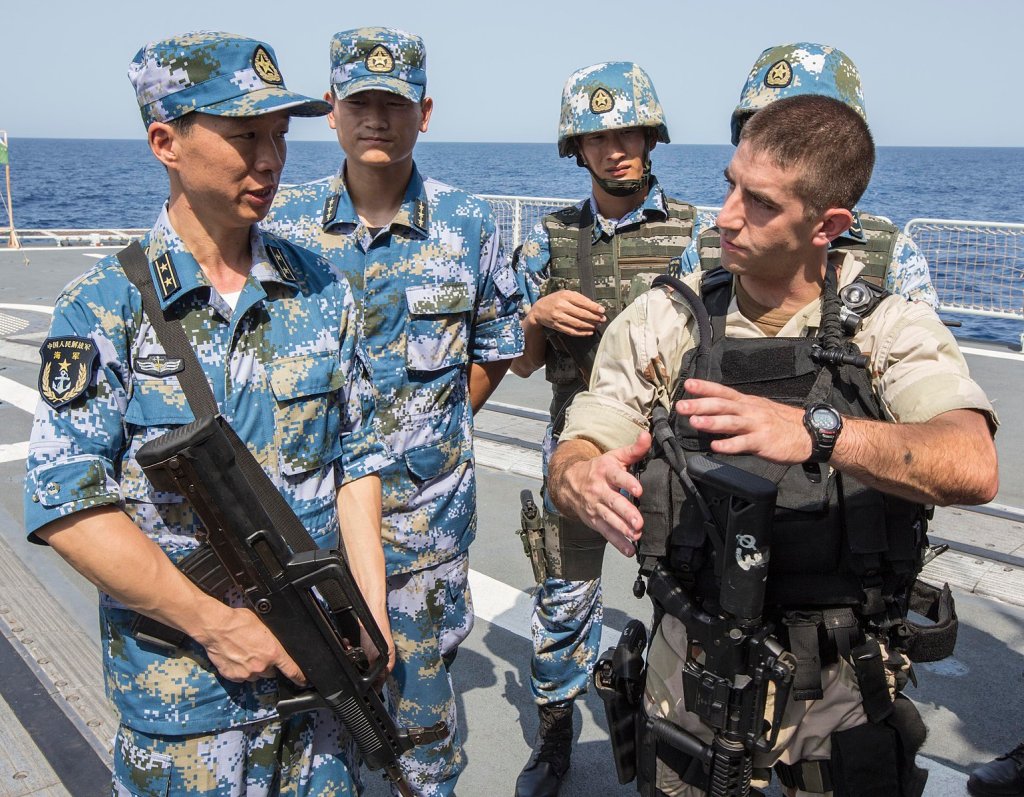
It’s not actually the Chinese People’s Liberation Army (PLA) that wears those blue digs, it’s the PLA Marine Corps that wears them. To be fair to China’s PLA Marines, there’s a bit of green, black, and gray in there, too, but it’s predominantly a powder blue on a deeper blue. It’s not pretty, but the reason they wear those things is the same reason for many facets of Chinese culture: tradition.
In this case, however, it’s not an ancient Chinese tradition; it’s more of a recent Chinese military tradition. Today, those PLA Marine Corps unis have a similar digital pattern that so many military forces have adopted since MARPAT was introduced to the United States Marine Corps in 2002. When they were first adopted, the swirling, colorful shapes were more akin to the U.S. woodland camo patterns that came on the battle dress uniforms.
These fashion nightmares were first introduced in 1987, before China became the rising dragon we think of today. It was still a nation with a long military history, but it was more concerned with defending itself, and less with rattling a saber over the territorial integrity of Taiwan. Fittingly called the Type-87 camo, the Chinese People’s Liberation Army Navy adopted the Type-87 for its Marine Corps and its primary duty.

Back in 1987, the PLA Marine Corps’ primary duty was standing guard on the islands the country (illegally) claimed in the South China Sea. It still claims them, but it has done so for a long time and has since built up a significant military presence on the islands, with much more than just a contingent of Marines to defend them.
Much of the water surrounding those islands in the South China Sea was predominantly blue, with hints of green. While the color choice may seem ridiculous to us in the West, it actually worked quite well for Chinese Marines in the South China Sea. These days, however, the old blue uniforms no longer need to be so blue, as the role of the PLA Marines in the Chinese military has evolved somewhat.
Today’s Chinese Marines are focused less on performing sentry duties and more on what Marines around the world do best: amphibious assaults and land-based combat. Although the uniforms may have gone digital and turned slightly darker, the dominant colors are still vivid blues – and that isn’t going to change anytime soon. The Chinese PLA Navy has fallen into the same kind of thinking that branches of the U.S. military fell into over the course of a decade: they like that it distinguishes the Navy from the Army.
Unlike the Americans, the colors used by the Chinese extend beyond uniforms. PLA Navy and Marine Corps vehicles and rocket launchers are also painted vivid hues of blue. They kept the blue out of the tradition of the Type-87 uniform and haven’t looked back… at least not yet. One day, they might find their own version of OCPs and switch.