
Everett Bartlett will never forget the huge cloud of smoke.
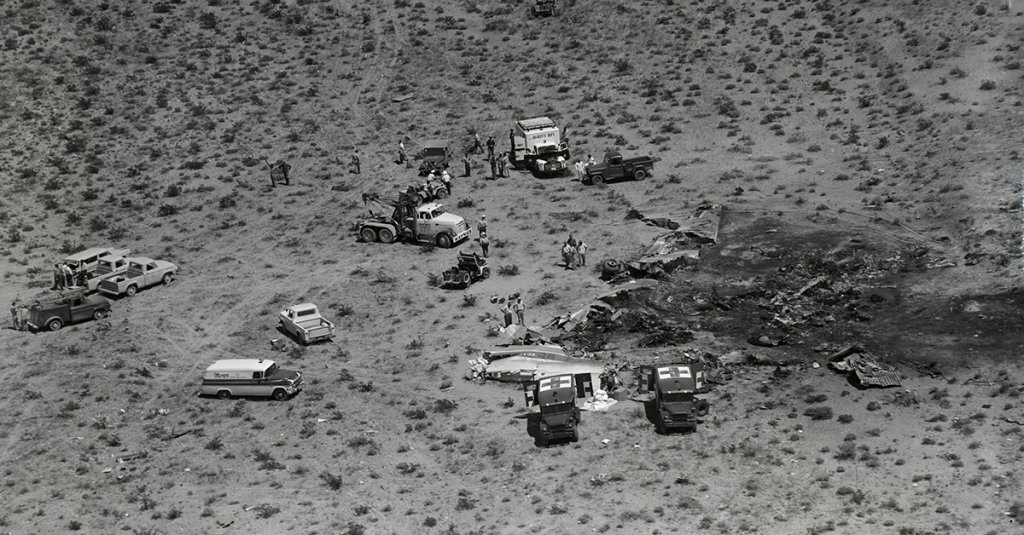
Bartlett was only 10 years old on April 21, 1958, when he saw the disturbing image off in the distance, a few miles from his school in Henderson, Nevada. The boy was outside at the time and didn’t know what to make of the smoke. He just knew it was bad.
“It looked like a mushroom cloud from an atomic bomb,” Bartlett recalled to KSNV, Las Vegas’ NBC television affiliate, in 2025.
Also Read: What happened on the final flight of the namesake for Edwards Air Force Base
Bartlett discovered what happened until he went home that night and saw a local news report detailing a midair plane collision. The crash involved a U.S. Air Force F-100 Super Sabre jet out of Nellis Air Force Base near Las Vegas and a commercial plane, United Air Lines Flight 736. The midair collision killed both men on the military aircraft—the pilot, Capt. Thomas Norman Coryell, and a student trainee, 1st Lt. Jerald Duane Moran—along with all 47 people on board United Flight 736.
It was the worst aviation accident in Nevada’s history and prompted Congress to transform how America’s skies are protected.
A Disaster at 21,000 Feet
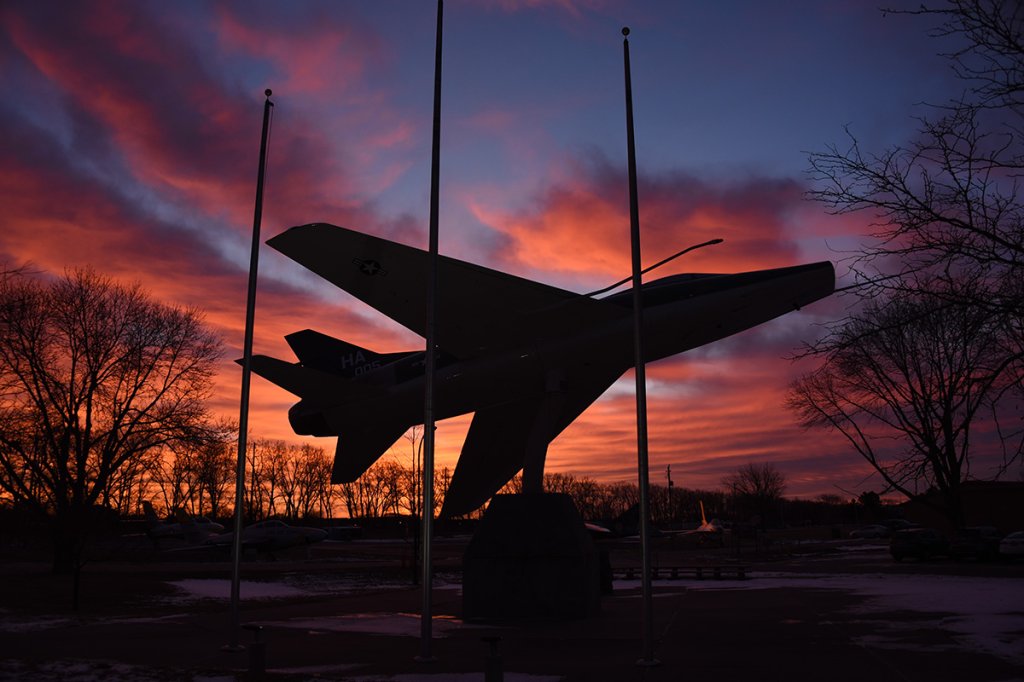
On that tragic morning, 13 people from the Ballistic Missile Division of the Strategic Air Command were among the passengers aboard the United flight in Los Angeles. They had no reason to suspect anything other than a routine day of travel. They were unaware that the F-100 Super Sabre out of Nellis took off an hour after their flight.
With Moran at the controls, the military aircraft intended to perform a rapid descent from 28,000 feet, KSNV reported. At that time, military pilots did not have to notify commercial air traffic controllers of their flight paths. That hadn’t been an issue in the past, but this time was horrifically different.
As the F-100 Super Sabre’s altitude decreased, it began to pose an imminent danger to United Flight 736. The military jet attempted to roll its way out of the civilian airplane’s route, KSNV reported. It was too late, however.
“If you’re 20 miles away from me, you’re going to look about the size of a tip of a pencil,” Daniel Bubb—a former commercial pilot who is now a professor at the University of Nevada, Las Vegas—explained to KSNV. “As you get closer, it’s going to get bigger and bigger. [Eventually you’ll] say, ‘Oh my gosh, it’s right here.’”
The two aircraft collided at 21,000 feet, shearing off wings on both planes. The impact created the enormous fireball that Bartlett saw miles away. The collision prompted not only aviation investigators to rush to the scene, but also the FBI. Agents were interested in securing any highly confidential information that those involved with the Ballistic Missile Division carried with them.
“They were not looking for survivors,” Faith Paris, whose husband Steve was one of the travellers from that division, told the Aero-News Network. “They were looking for papers.”
An Earlier Incident Caused Concern
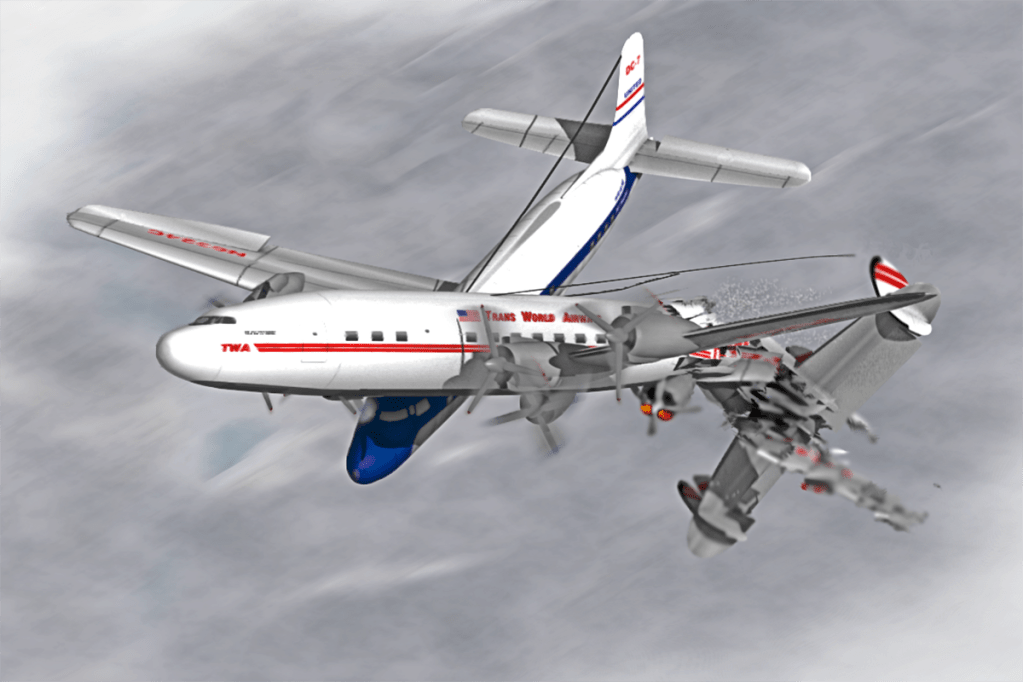
Two years before the accident near Las Vegas, another crash raised concerns. This tragedy involved Trans World Airlines Flight 2 and United Airlines Flight 718, which collided above the Grand Canyon in Arizona on June 30, 1956.
While the TWA plane was bound for Kansas City, Missouri, the United flight was on its way to Chicago. Both departed Los Angeles International Airport at almost the same time, their takeoffs separated by only three minutes. According to records, TWA Flight 2 began on a northerly route with an altitude of 19,000. Meanwhile, United Flight 718 started off in a southerly direction and was traveling at 21,000 feet.
After the TWA flight encountered turbulence, its pilot, Capt. Jack S. Gandy, requested permission to fly at 21,000 feet. Because of the presence of the United airplane, air traffic controllers denied that request. Gandy then received approval to fly a thousand feet above any cloud cover. Controllers told Gandy that United Flight 718 would be in his vicinity, according to a Grand Canyon historical website.
About 2½ hours later, a missing aircraft alert went out. The collision resulted in 128 deaths, making it the deadliest aviation accident to that point in U.S. history.
Safeguarding the Skies
The Civil Aeronautics Board released its accident report regarding the collision between the F-100 Super Sabre and United Flight 736 on August 19, 1958. In it, the board blamed the Air Force for not taking “adequate account of human limitations to avoid collision by visual means although the limitations were recognized in other training operations and were known to the Air Force.” The board also called out the Civil Aeronautics Administration for its failure “to reduce known collision exposure in visual flight conditions.”
“In the aftermath, when it was investigated, there were a number of things that were discovered,” Nevada historian Mark Hall-Patton said. “There were blank areas where they couldn’t see each other. They were moving too fast. The impact was estimated at about 770 mph, so there was no time to take any real evasive maneuvers.”
The tragic accidents in 1956 and 1958 prompted governmental action as well. Less than a week after the release of the 1958 accident report, President Dwight Eisenhower signed the Federal Aviation Act. The legislation created the Federal Aviation Agency, which is now the Federal Aviation Administration. It gave the FAA unprecedented control in policing airspace for both civilian and military aircraft.
While air travel is never totally safe—as the January 29, 2025, crash of a U.S. Army Black Hawk helicopter and an American Eagle jet near Washington, D.C., sadly proved, killing 67—it is a lot safer because of the Federal Aviation Act.
“Anytime there is a tragedy like [the 1958 collision], it led to substantial changes in commercial and military flights when they were in the same airspace,” Hall-Patton told KSNV. “What ends up happening after these kinds of tragic incidents is, it makes the future much safer. It doesn’t make it any nicer that it happened.”
Don’t Miss the Best of We Are The Mighty
• A Vietnam War pilot who purposely went down with his plane may receive the Medal of Honor
• The story behind the World War II aircraft that started Air Force One
• An Air Force plane crashed in Death Valley during the Cold War (and is still there)

Loading comments…
Comments couldn’t be loaded. Please refresh the page.