
The Civil War challenged the loyalties of countless Americans across the nation, tearing apart families and destroying friendships. Far from the clear division between North and South that many subpar summaries of the Civil War project, the conflict forced some of the nation’s leading and rising military officers to choose sides based on competing loyalties, views on slavery and secession, political convictions, and their understanding of the obligations of federal service.
Also Read: 12 strange and surprising facts about the Civil War
This was especially evident in the seceding Southern states, where officers in both the Army and Navy were forced to choose between the Confederacy and the Union. For some officers, such as future Confederate Gen. Robert E. Lee, this decision was a difficult one that required weeks of careful contemplation and self-reflection.
For other officers, such as Lee’s cousin, U.S. Navy officer Samuel Phillips Lee, there was little outward indication of the same hesitation.
Southern Unionism existed throughout the Confederacy during the Civil War. The opposition to secession was most evident in the Upper South, where Unionists organized regiments to oppose the Confederacy throughout the war. Samuel Lee was one of many senior officers in the Army and Navy whose place of birth or ancestral ties to seceding states did not weaken his commitment to the Union.
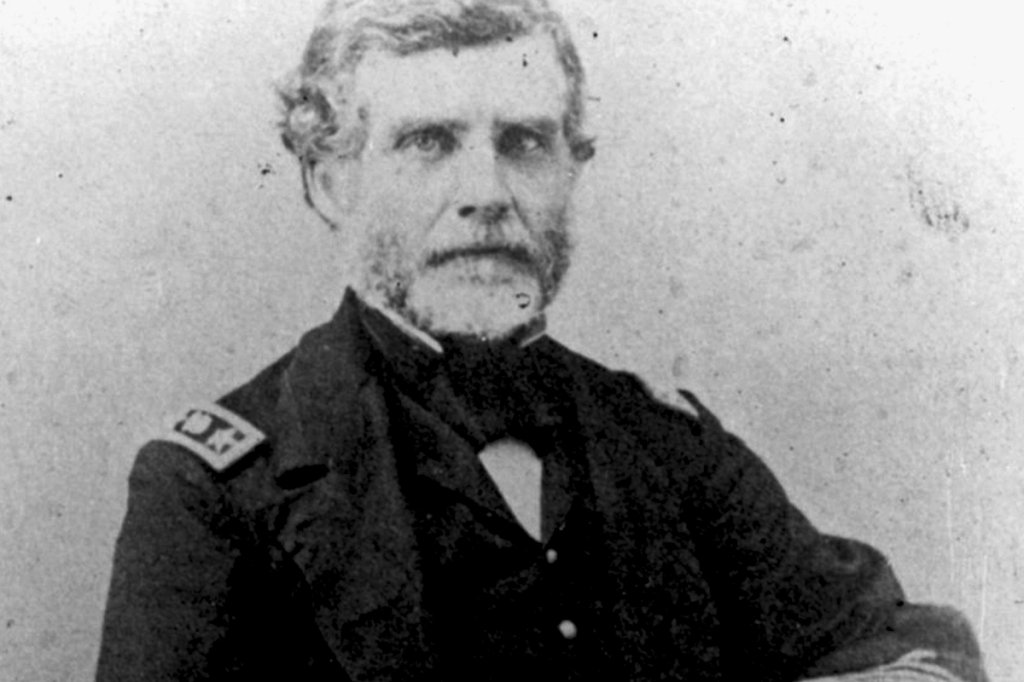
A number of Southern officers honored their oath to the United States, and served with distinction, including native Virginian Generals Winfield Scott and George H. Thomas. Joining these notable military commanders were political leaders like Tennessee Senator and future Vice President Andrew Johnson.
Yet, in addition to facing Confederate fire on the battlefields and seas of the conflict, family pressure, and threats to property, these men encountered additional scrutiny from Northern-born officers who questioned their allegiances.
During and in the years following the Civil War, loyal Southern officers were asked about their decision to stay with the Union. According to numerous sources, when Samuel Phillips Lee was asked about his decision to remain loyal to the Union during the Civil War, he responded, “When I find the word Virginia in my commission I will join the Confederacy.”
Early Life and Navy Beginnings
Born at Sully Plantation in Chantilly, Virginia, on Feb. 13, 1812, Samuel Phillips Lee was the son of Francis Lightfoot Lee II and his wife, Jane (née Fitzgerald). A grandson of Richard Henry Lee (famed statesman and signer of the Declaration of Independence) Samuel descended from a family prominent in Virginia politics, military affairs, and business.
Samuel was a cousin of Robert E. Lee, sharing a great-great-grandfather, Richard Lee II.
At the age of 13, and aided by his family connections, Lee was appointed a midshipman in the U.S. Navy on November 22, 1825. This appointment was the start of a career that spanned nearly 50 years, numerous assignments, travel around the world, and two major conflicts.
Lee was promoted to lieutenant on Feb. 9, 1837. During his early naval career, he participated in the United States Exploring Expedition of 1838-1842, serving aboard several vessels during the ambitious scientific and surveying mission commonly known as the Wilkes Expedition.
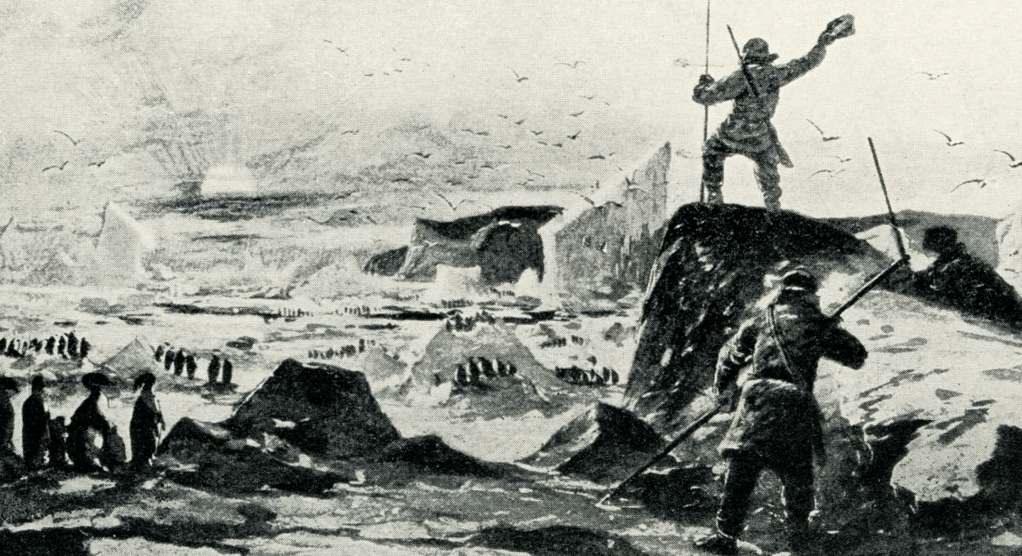
The voyage carried American naval personnel around the globe and provided Lee with valuable experience in exploration, navigation, and surveying that would remain important throughout his career.
Marriage
In the years following this promotion to lieutenant, Lee began a long and, at times, difficult courtship with Elizabeth Blair, the daughter of Francis Preston Blair and Eliza Violet Gist Blair. Francis was a respected advisor to multiple American presidents who rose to national prominence as a journalist and editor.
The couple’s path to marriage was complicated by Francis’ early opposition to the relationship and Lee’s lengthy periods at sea. Despite these challenges, the 31-year-old Lee married his 24-year-old bride on April 27, 1843. This union between the Blair and Lee families created a powerful political connection that would last for generations.
Two years after his marriage, Lee’s likeness was captured in a painting by prominent American artist Thomas Sully. In 1840, his wife Elizabeth had sat for the same artist. Both oil-on-canvas portraits remain part of the Blair House Collection in Washington, D.C.
The Mexican-American War
Following years of deteriorating relations between the United States and Mexico, Congress declared war on May 13, 1846, after President James K. Polk asserted that Mexican forces had invaded American territory and attacked U.S. troops along the disputed Texas-Mexico border.
Although highly controversial among political leaders and citizens, Americans answered the call for volunteers as U.S. forces advanced into Mexican-held territory.
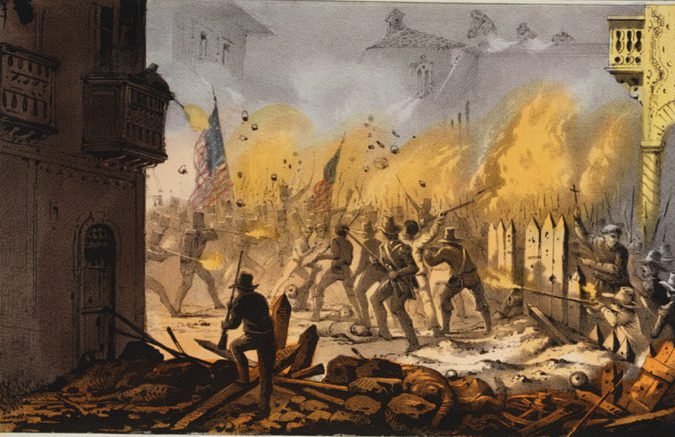
Lee saw combat during the war and, according to some sources, was wounded during the conflict. He was present during the capture of Tabasco, Mexico, by American naval forces under Commodore Matthew C. Perry on June 16, 1847. Then-Lt. David D. Porter, who would become one of the U.S. Navy’s most prominent officers, also played a significant role in the operation, leading a landing party of sailors and Marines in an assault on Fort Iturbide along the Tabasco River.
Perry’s victory resulted in the capture of San Juan Bautista, the last major Mexican port on the Gulf coast still in Mexican hands.
Samuel’s cousin Robert also played a prominent role in the war, serving as an engineer and staff officer under Gen. Winfield Scott. His reconnaissance and engineering work contributed to the success of Scott’s campaign from Veracruz to Mexico City. The Mexican-American War concluded with the signing of the Treaty of Guadalupe Hidalgo on Feb. 2, 1848.
Return to a Peacetime Navy
A return to a peacetime posture in the Navy meant that, despite extensive service at sea, Lee would remain a lieutenant for nearly 18 years. Although advancement proved slow, he continued to make important contributions to naval exploration and scientific research.
In 1851, Lee commanded USS Dolphin on an important surveying and oceanographic mission. This surveying brig departed the New York Navy Yard and sailed throughout the North and South Atlantic. During the cruise, Lee and his crew conducted deep-sea soundings, studied ocean currents, and searched for shoals and other hazards reported by mariners while ranging from the waters off South America and Brazil to the Canary and Cape Verde Islands.
The expedition was conducted under the direction of noted U.S. Navy officer and oceanographer Matthew Fontaine Maury, a fellow Virginian whose pioneering research into winds and ocean currents helped establish him as one of the leading figures in early American oceanography.
Lee’s findings contributed valuable information to Maury’s continuing oceanographic research. Unlike Lee, Maury later resigned his U.S. Navy commission and sided with the Confederacy during the Civil War. Lee later documented the expedition in his 1854 publication, “The Cruise of the Dolphin.”
Seven years after the Treaty of Guadalupe Hidalgo, in 1855, Lee was finally promoted to commander. This relatively slow progression through the ranks, compared with more contemporary times, was due in large part to the small antebellum Navy, which relied heavily on seniority for highly coveted promotions.
Peacetime service significantly limited career opportunities and advancement for experienced and decorated veterans like Lee. However, much like their military brethren in the Army, the looming Civil War and rapid expansion of Union forces would open the door for advancement in a Navy that was itself divided by the conflict.
On Aug. 9, 1857, the Lee family welcomed their first and only child, Francis Preston Blair Lee. Born in Maryland, he would call the state home for the rest of his life and later represent it in the U.S. Senate. This period of Lee’s life also marked a transition from sea service to shore duty for the new father.
From 1858 to 1860, he served on the Navy’s Board of Examiners in Washington, D.C. In the nation’s capital, Lee’s father-in-law had a home built for the family. Lee House was completed in 1859 and stood immediately adjacent to Blair House, the home of Francis Preston Blair, just a short distance from the White House.
Today, both buildings form part of the Blair House complex, officially known as the President’s Guest House.
On Nov. 1, 1860, Lee received command of the sloop-of-war USS Vandalia. With already heated debates over slavery and secession intensifying in the halls of government, Lee and his crew were ordered to the East Indies, but as Vandalia got underway, the crisis reached its breaking point with the election of Abraham Lincoln as President of the United States on Nov. 6, followed by the secession of South Carolina on Dec. 20.
The Civil War
Lee learned of the country’s descent into Civil War while commanding Vandalia, then part of the East India Squadron. With many sources placing the ship off the Cape of Good Hope, Lee, without official orders, directed his ship to return to the United States. Following South Carolina and the fledgling Confederacy’s April 12 attack on Fort Sumter and Lincoln’s call for volunteers, Virginia threw its lot in with the seceding states days later.
With Virginia went Robert E. Lee, who resigned his commission in the U.S. Army on April 20 and accepted command of the state’s military forces on April 22.
Samuel’s actions backed up his commitment to the oath he had taken upon receiving his commission in the Navy. This decision stood in stark contrast to Robert E. Lee and scores of other Southerners who resigned from the United States military to join the Confederacy.
Upon returning to the United States, the 49-year-old went to work supporting Union blockade operations off the coast of Charleston, South Carolina, one of the central wartime objectives of the Union Navy.
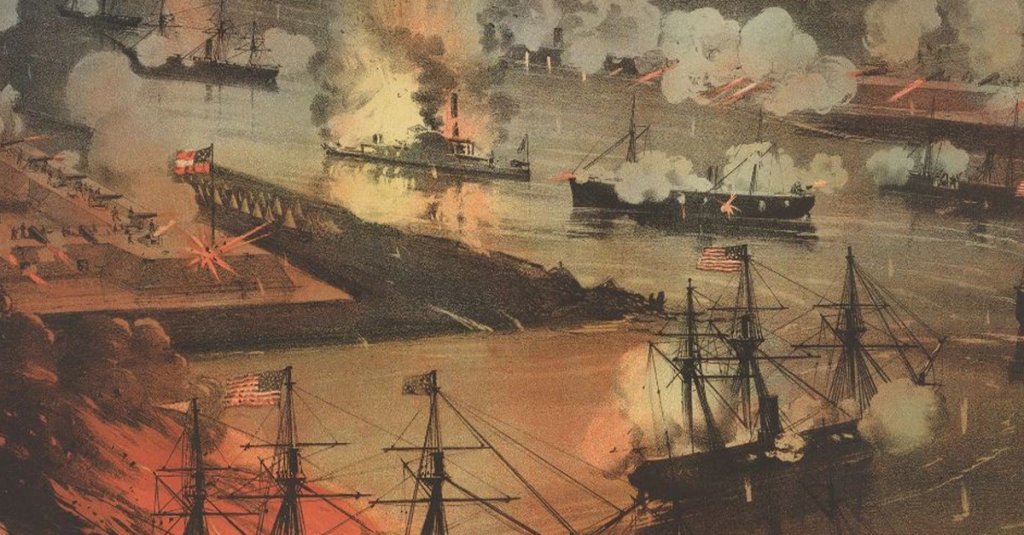
Lee next commanded the screw sloop-of-war USS Oneida during Flag Officer David Glasgow Farragut’s 1862 New Orleans campaign. Oneida participated in operations against Fort Jackson and Fort St. Philip, Confederate positions that guarded the Mississippi River approaches to New Orleans.
Farragut, a Southern Unionist from Tennessee, led his fleet past the forts during the early morning hours of April 24. Lee and Oneida successfully passed the Confederate defenses and participated in the fierce fighting that opened the way to New Orleans.
During the engagement, Oneida also came to the aid of USS Varuna, which suffered heavy damage after being rammed by Confederate vessels. Lee and his crew helped drive off the Confederate ram attacking Varuna before engaging CSS Governor Moore, which was ultimately destroyed in the fighting.
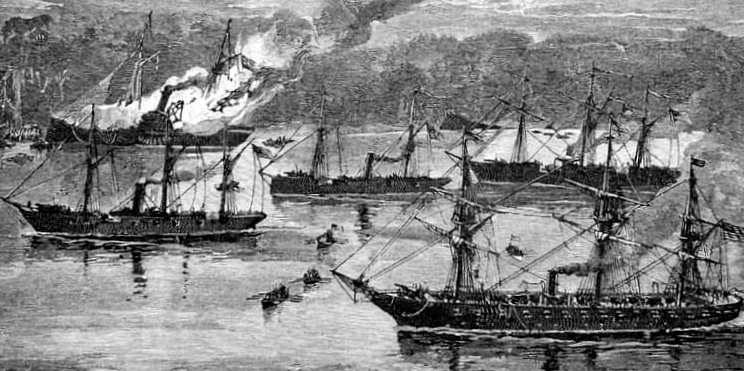
These actions added to the success of Farragut’s fleet as it fought its way through the Confederate defenses and continued toward New Orleans.
The capture of the Confederacy’s largest city and one of its most strategically important ports was a major victory for the Union. Farragut’s ships reached New Orleans on April 25, and on May 1, Maj. Gen. Benjamin Butler led approximately 5,000 Union troops into the city to begin its military occupation. New Orleans remained under Federal control for the rest of the war.
Following the capture and occupation of New Orleans, Farragut’s naval forces continued up the Mississippi River. Lee and the crew of Oneida engaged in combat operations during the early Union campaign against the Confederate stronghold of Vicksburg, a heavily fortified position perched on high bluffs along a hairpin turn of the river.
Despite intense Union naval pressure on the “Gibraltar of the Confederacy,” the city would not fall to Union forces until July 4, 1863, when Maj. Gen. Ulysses S. Grant accepted its surrender following a 47-day siege.
Commander Lee was promoted to captain on July 16, 1862. Two months later, he received command of the North Atlantic Blockading Squadron and the wartime rank of acting rear admiral. The appointment represented a dramatic increase in responsibility for Lee, who had commanded a single warship during the New Orleans campaign only months earlier.
He was now responsible for a large and geographically dispersed naval force operating along the coasts and inland waters of Virginia and North Carolina. Lee’s squadron was charged not only with enforcing the Union blockade and intercepting blockade runners, but also with supporting Army operations, protecting Union positions, and conducting combat operations throughout the region’s rivers, sounds, and coastal waterways.
The squadron also maintained pressure on Wilmington, North Carolina, which emerged as one of the Confederacy’s most important blockade-running ports as the war progressed. He would remain in command of the squadron for more than two years.
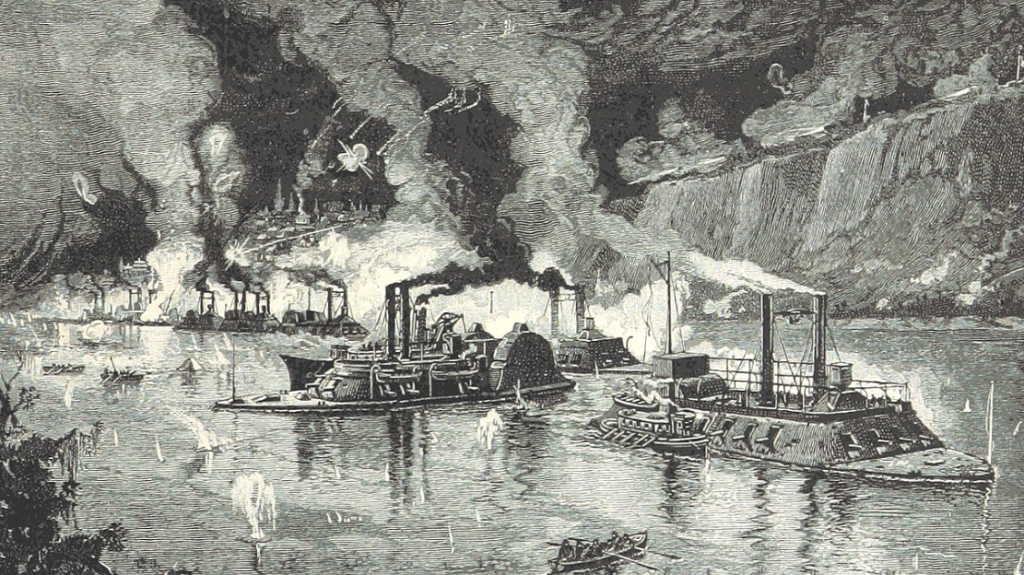
In October 1864, Rear Adm. Lee was transferred to command the Mississippi Squadron, where he directed naval operations throughout much of the western river system, including the Mississippi, Cumberland, and Tennessee Rivers. He remained in command of the squadron until the war’s end.
In this capacity, Lee worked closely with Union Army commanders and played an important role during Confederate Lt. Gen. John Bell Hood’s Tennessee Campaign in late 1864. As Hood’s army advanced toward Nashville, Lee’s vessels helped keep the strategically vital Cumberland River open to Union traffic, protecting transports and maintaining the flow of supplies, reinforcements, and communications to the forces of Union Maj. Gen. George H. Thomas, a fellow Virginian.
His squadron also worked to counter Confederate efforts to disrupt navigation and interfere with Union movements along the Cumberland. Lee’s naval support continued through the decisive Battle of Nashville in December 1864, when Thomas’s forces defeated Hood’s Army of Tennessee. Thomas later thanked his fellow Southern Unionist for the squadron’s cooperation with ground forces under his command.
Postbellum
Following the Civil War, Lee reverted to his permanent rank of captain in the Navy. Between 1866 and 1867, he served in Washington, D.C., as president of a board of officers examining volunteer naval officers for admission into the Regular Navy. Promoted to commodore in 1866, Lee continued to hold a series of senior assignments in and around the nation’s capital.
On April 22, 1870, Lee was promoted to the permanent rank of rear admiral. He commanded the North Atlantic Squadron from 1870 to 1872 before retiring from the Navy in February 1873.
Retirement and Death
Lee spent his remaining years splitting time between Washington, D.C. and his father-in-law’s country estate in Silver Spring, Maryland. There, he spent much of his retired life managing the day-to-day activities of the farm. He died at the Silver Spring estate in June 1897 following a stroke.
Newspaper obituary headlines remembered the famed admiral as the “Last of His Class” and the “Last of the Admirals Who Commanded Great Squadrons During the Civil War.”
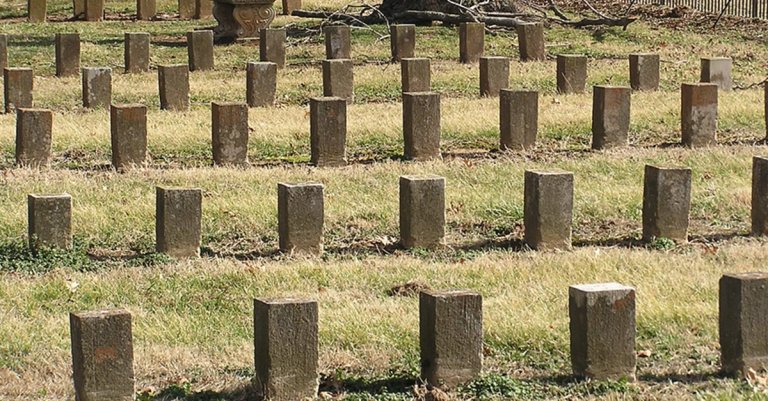
In a particularly ironic twist, Lee was buried at Arlington National Cemetery, the former home of his cousin Robert E. Lee and Robert’s wife, Mary Anna Randolph Custis Lee. The federal government acquired the Arlington estate through a tax sale in 1864, and its grounds became a burial place for Union soldiers during the Civil War.
Robert E. Lee’s eldest son, George Washington Custis Lee, successfully challenged the seizure after the war, regaining legal title before selling the estate to the federal government in 1883. Arlington subsequently remained one of the nation’s most important burial grounds for military veterans and government officials.
Legacy and Namesakes
Lee’s legacy was preserved in two U.S. Navy vessels named in his honor. USS S. P. Lee (DD-310), a Clemson-class destroyer commissioned in October 1920, was lost by stranding during the Honda Point disaster on September 8, 1923, the largest peacetime loss of U.S. Navy ships in American history.
A particularly appropriate second namesake, USNS S. P. Lee (T-AGS-31, later T-AG-192), was a hydrographic survey and oceanographic research ship that entered naval service in 1968 and remained in service until 1974. The vessel was later operated by the University of Hawaii as R/V Samuel P. Lee before being returned to the Navy in 1992. It was subsequently sold to the Mexican government and transferred to the Mexican Navy, where it was renamed Antares.
Don’t Miss the Best of We Are The Mighty
• The Civil War created the modern American funeral industry
• 5 reasons why John Bell Hood was the worst Civil War general
• The Civil War started and ended at the same guy’s house
Loading comments…
Comments couldn’t be loaded. Please refresh the page.