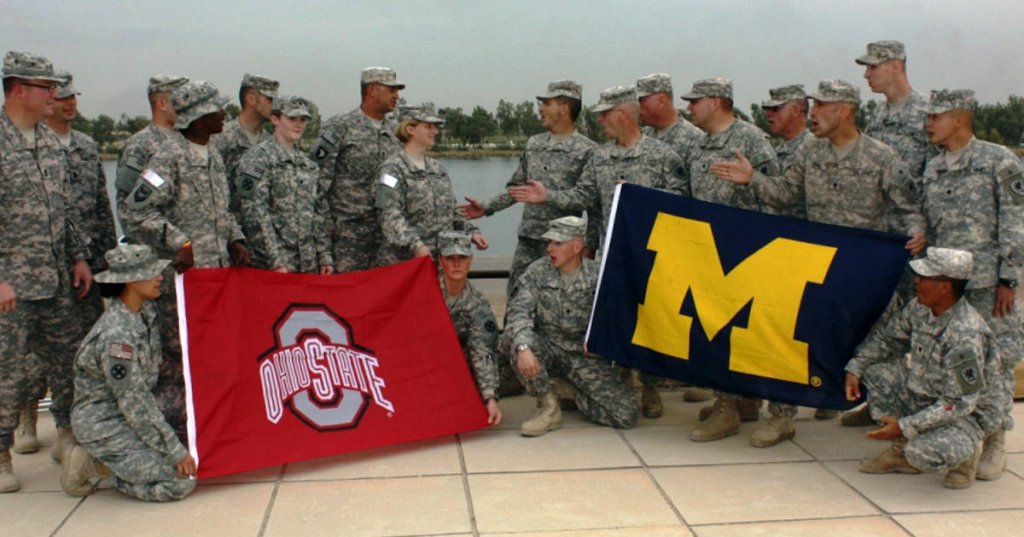
Forget Texas and Oklahoma, Alabama’s internal division, or even the rivalry between Army and Navy. There’s only one state rivalry that ever erupted into armed conflict: the Ohio State-Michigan rivalry.
The reason? Toledo. Yes, Toledo.
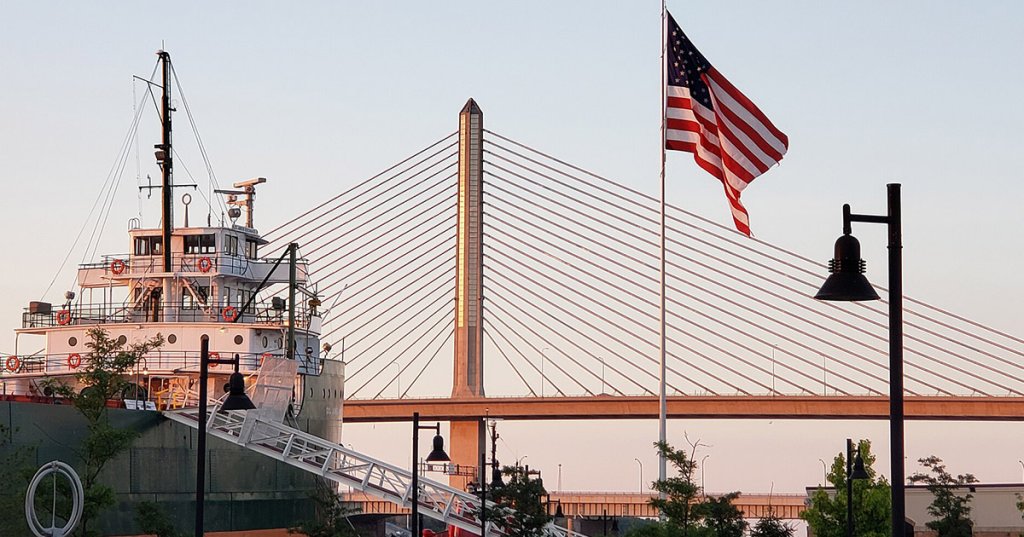
Admittedly, the Toledo War wasn’t over football. It was because of a poorly drawn map. The Northwest Territory, the area we now know as Wisconsin, Illinois, Indiana, Ohio, and Michigan, was the first expansion of the United States after the American Revolution. It was set to be divided into five future U.S. states. Michigan’s southern border was supposed “an east and west line drawn through the southerly extreme of Lake Michigan, running east… until it shall intersect Lake Erie.”
But the best map they had didn’t show that line would ever intersect with Lake Erie. So Ohioans believed the border should be much further north, covering the entire western shore of Lake Erie. When they found out they might be wrong about the southern tip of Lake Michigan, Ohio moved to include ownership of the mouth of the Maumee River (in Toledo) in its constitution. When it created the Michigan Territory two years later, Congress ignored Ohio and used the original boundary.
When Congress decided to actually conduct a survey of the border line, U.S. Surveyor General (and former Ohio governor) Edward Tiffin chose William Harris to draw the line. Harris, amazingly, chose the line in the Ohio constitution. Michigan hired its own man to survey the line, which became the original intended boundary. The area in between became known as the Toledo Strip. This is where the dispute became a shooting war.
Michigan occupied the strip, which was a critical trade and transportation hub. Control of the city meant control of the Lake Erie coastline and complete control of the Maumee River. When Michigan began its path to statehood in 1833, Congress rejected it until it could end the dispute over Toledo. Ohio blocked Michigan’s attempts at statehood in Congress and began setting up county lines in the disputed territory. Michigan organized a militia to maintain control of the strip by force, and Ohio responded by organizing its own.
Ohio’s importance as a swing state for Andrew Jackson’s Democrats led to a mediated settlement that put the Toledo area in Ohio’s borders, even though Michigan was (technically) right. Michigan responded by attacking the surveyor teams sent to mark the new Ohio boundary at Phillips Corners. It then tried to force its admittance to the Union, but these acts were ignored by the U.S. government. President Jackson offered Michigan the Upper Peninsula if it would cede the Toledo Strip. Still, Michigan refused the offer… until the Treasury Department began to provide budget surpluses back to states – not territories. Michigan relented to get a cut of that money.
The Toledo War (as it came to be called) sparked more than just a long-lasting rivalry.
The “war” saw a total of 50 bullets fired, injuring one militiaman in the leg. While Ohio won the war for Toledo, Michigan gained its statehood and its resource-rich Upper Peninsula as an added bonus. The record remained 1-1 for another 60 years when the states began to settle their scores through college football.