Gen. Douglas MacArthur did not become one of the United States military’s greatest generals by making miscalculations.
He made a huge one during the Korean War, though. Believing the North Korean army was disorganized and lacking sufficient supplies, MacArthur promised his forces in October 1950 that they would be home by Christmas.
Related: A guide to the Battle of Chosin Reservoir
At that point, the Korean War was only four months old. In his role as supreme commander of United Nations Command forces, a confident MacArthur doubled down on his initial proclamation in a talk with Maj. Gen. John B. Coulter.
“You tell the boys that when they get to the Yalu [River] they are going home,” MacArthur said, according to The Associated Press. “I want to make good on my statement that they are going to eat Christmas dinner at home.”
MacArthur made that boast on November 28, 1950. The day before, the Battle of Chosin Reservoir began, ensnaring U.S., Republic of Korea (ROK), and UN forces into the fight of their lives.
China’s Entry into the Korean War
MacArthur underestimated that China would make good on its threat to fight alongside the North Koreans if opposing forces got too close to the countries’ shared border.
Even after 200,000 Chinese soldiers crossed the Yalu River and poured into North Korea on October 19, MacArthur didn’t fully grasp the situation. The picture became abundantly clear at Chosin Reservoir, an engagement that lasted 2½ weeks and involved 30,000 pro-South Korea forces, including about 12,000 U.S. Marines from the First Marine Division and a few thousand U.S. Army soldiers.
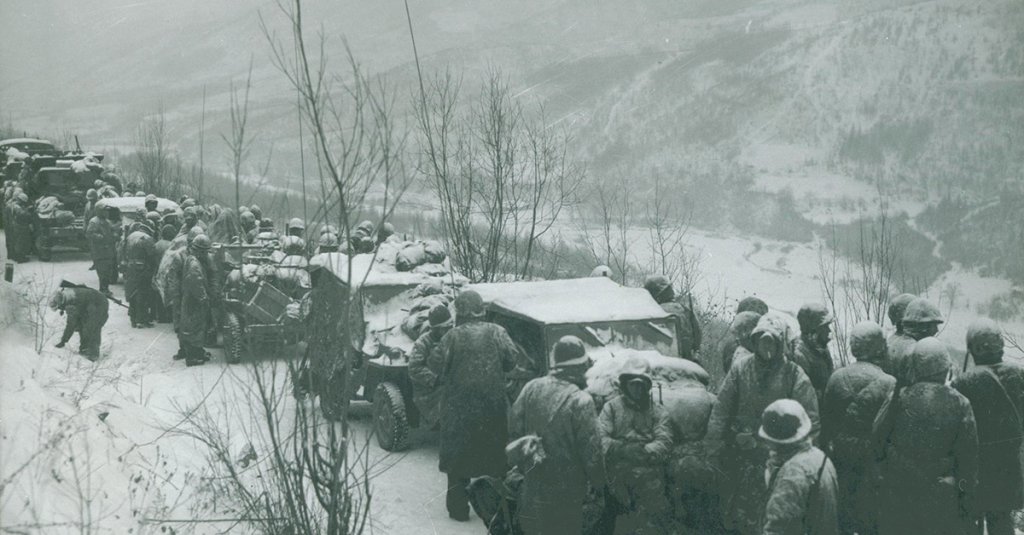
Those men were ill-prepared from what lay ahead, especially the brutally cold conditions. Temperatures sometimes reached as low as 35 degrees below zero, leaving the inadequately clothed soldiers trying desperately to stay warm while the Chinese and North Korean fighters vastly outnumbered them.
“Feet in leather boots froze,” Col. David Hackworth recounted in his and co-author Julie Sherman’s book, “About Face: The Odyssey of an American Warrior.” “Gloves and mittens were as scarce as good-looking girls. Our field jackets were as thin and protective as Page 1 of the newspaper. We were slowly freezing to death in the bitter below-zero weather, while the Chinese, like Genghis Khan’s mighty hordes, marched on seemingly unstoppable.”
The 1st Marine Division
Fighting in mountainous terrain compounded the effects of the mind-numbing cold, but the American troops fought valiantly. None did more so than the 1st Marine Division, now the Corps’ oldest division.
On the third day of fighting, more than 100,000 Chinese People’s Volunteer Army (PVA) soldiers surrounded Company F, 2nd Battalion, 7th Marines, 1st Marine Division and its commanding officer, Capt. William Barber. At Toktong Pass, Barber and his men bravely held on for five interminable days despite the enemy’s relentless attacks.
In doing so, they protected the division’s main supply line. In the bigger picture, though, the UN forces were not in a good position. They were fighting, often in hand-to-hand combat, against an aggressive, more fortified enemy.
How long that was sustainable remained an open question. Something had to change.
The “Backward Advance” out of Chosin Reservoir
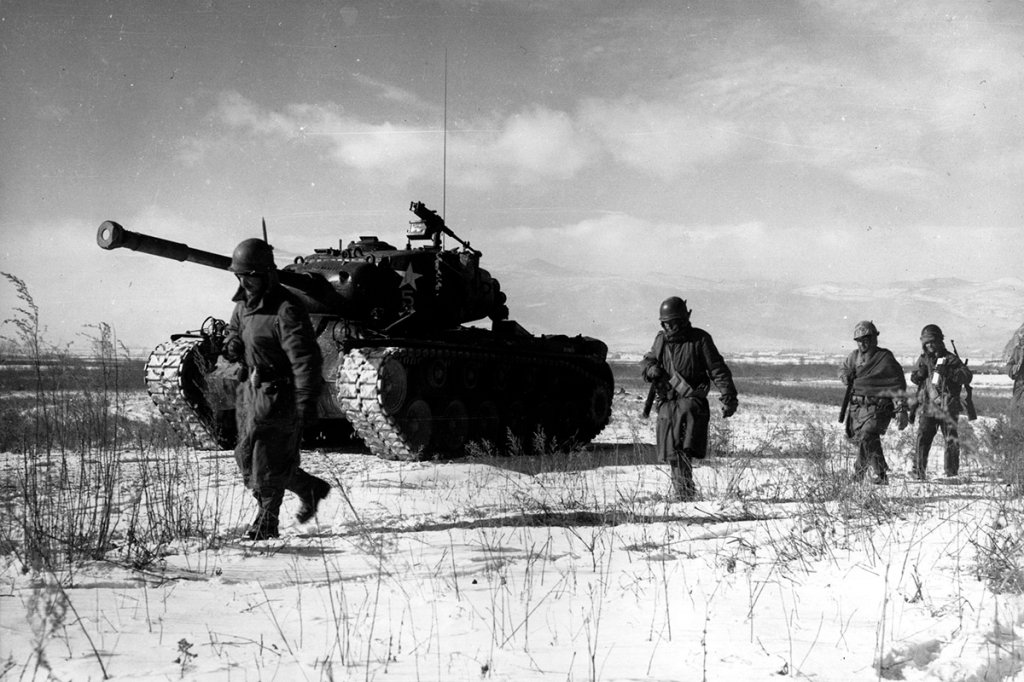
Ten days after the battle began, the Americans started to break out of Chosin Reservoir.
Four-star Gen. Oliver P. Smith, commanding general of the 1st Marine Division, disputed some who called it a retreat.
“I’m going to fight my way out,” Smith proclaimed. “I’m going to take all my equipment and all my wounded and as many dead as I can. If we can’t get out this way, this division will never fight as a unit again.”
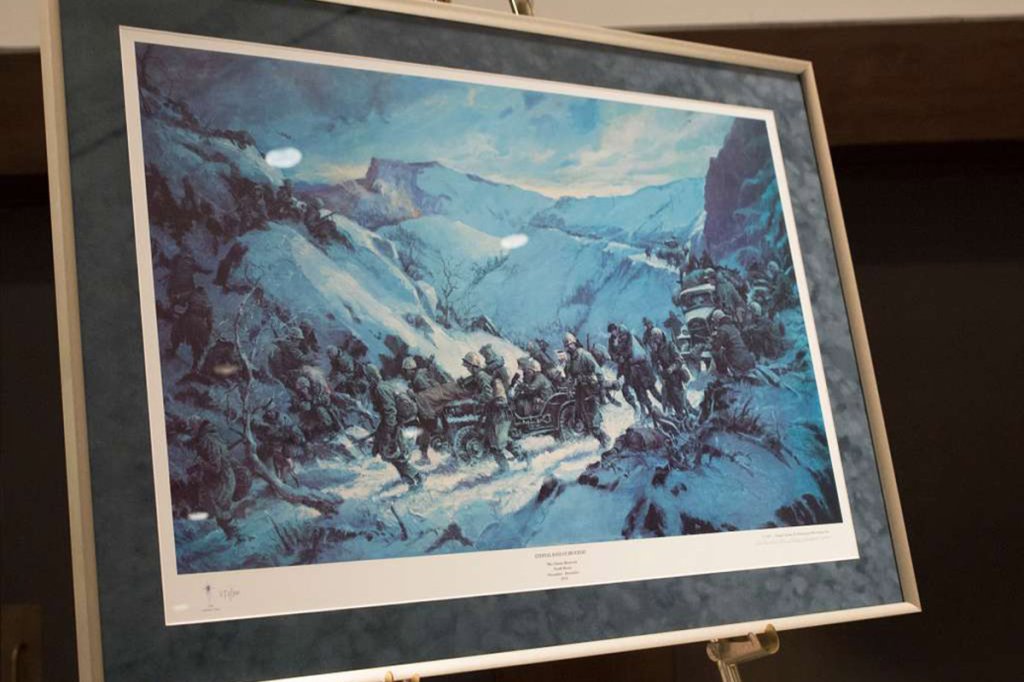
Despite the harshest elements anyone could imagine, Smith’s plan worked. Fighting “a backward advance,” the Marines managed to make their way down the Korean peninsula toward the port of Hungnam. They covered nearly 80 miles in five days, and once they arrived at the port, nearly 200 ships evacuated the battle-worn UN forces and civilian refugees.
Heroism Amid the Carnage
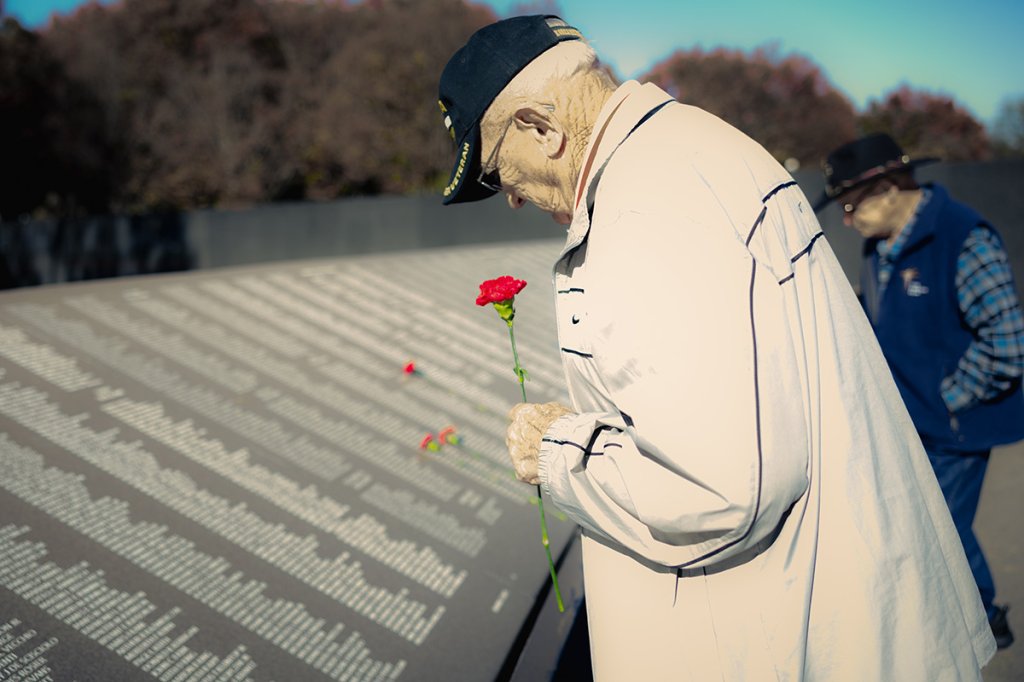
Those who survived the Battle of Chosin Reservoir have been called “the Chosin Few” and “the Frozen Chosin.”
It’s with good reason. Approximately 6,000 U.S. service members died or were missing, according to the Marine Corps’ official website. Thousands more were wounded or suffered from severe frostbite. Some were left behind high in the mountains of North Korea because of the unrelentingly frigid elements.
While Americans suffered terribly at the Battle of Chosin Reservoir, they also performed countless acts of heroism. Some were recognized later with the U.S. military’s highest individual award for valor. Ten Marines, two Army officers, and one Navy pilot received the Medal of Honor for their actions there, per the Congressional Medal of Honor Society.
Despite MacArthur’s prediction, the Korean War lasted way beyond the holidays in 1950. It trudged on for more than 2½ years before an armistice ended the fighting on July 27, 1953.