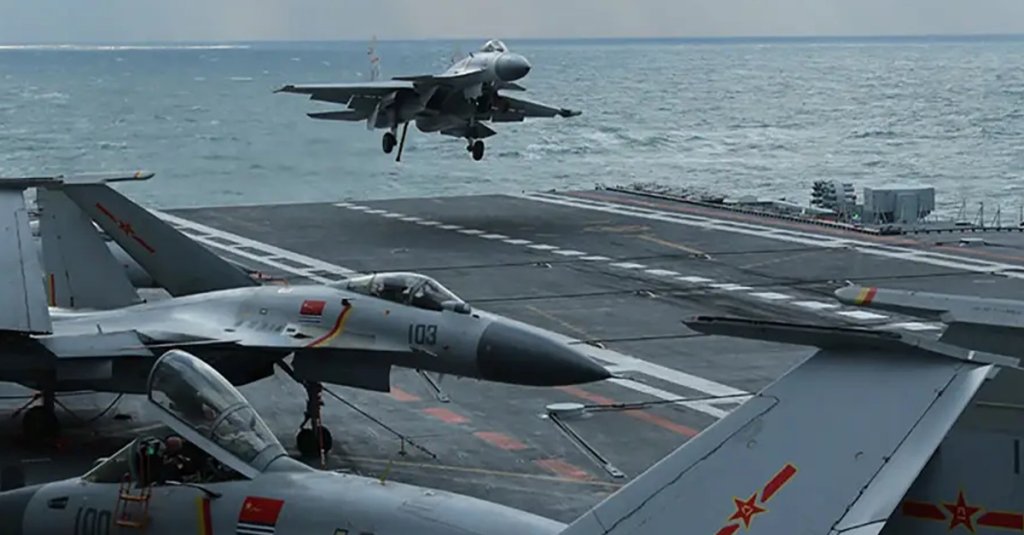
The People’s Liberation Army Navy might have a ridiculous name, but it’s starting get some serious weaponry. A Chinese Shenyang J-15 “Flying Shark” was recently spotted carrying two YJ-15 anti-ship missiles, and that little detail is a loud message about reach, targeting, and making life harder for everyone operating inside the first island chain.
This wasn’t a conceptual mock-up or a test flight. It was a carrier-based fighter, in flight, sporting a pair of YJ-15 supersonic anti-ship cruise missiles powered by ramjet engines. This means the weapon is far enough along to be in a real configuration, not just a Putin-style flex that really means nothing.
Also Read: 4 Massively over-hyped Russian weapons systems
The YJ-15 first showed up publicly during a September 2025 military parade in Beijing, alongside other new anti-ship systems labeled YJ-17, YJ-19, and YJ-20. And being on a J-15 is important because that fighter is the workhorse of China’s carrier air wings. If you’re trying to add punch to your carrier groups fast, you arm the jet you already have in quantity.
The Highway to the Danger Zone is suddenly a Cul-de-Sac
China has not published official YJ-15 specs, a classic communist military move. But outside analysis suggests these newer air-launched anti-ship missiles could reach roughly 1,200 to 1,800 kilometers (about 750 to 1,120 miles) and potentially exceed Mach 5. Even if real-world performance comes in lower, the point stands that the YJ-15 is a big leap from older options like the YJ-12, which has about half that range.
If those estimates are even partly right, an enemy surface ship’s comfortable operating space is suddenly much smaller, and its decision time much tighter. It pushes the threat ring outward and buys the launching aircraft more standoff distance.
The Medium is the Message
Even without a spec sheet, the YJ-15’s visible configuration is an air-breathing, high-speed design, likely in the ducted-ramjet family based on the intake layout and overall form. That’s consistent with a supersonic ship-killer’s job description, and it fits the way China included multiple new maritime strike missiles into its 2025 parade narrative.
But the real story is what this does to carrier aviation strike geometry. This means it’s not just about the missile, it’s also about finding the target, tracking it, and feeding that information to the shooter.
China’s newer carrier, Fujian, was built for catapult operations, which changes what carrier-based aircraft can launch. Catapults mean heavier takeoff weights, which means more fuel, more weapons, and less compromise. Public reporting has pegged Fujian in the 80,000-ton class, with an embarked air wing at around 40 aircraft, plus catapult testing that included the J-35, J-15, UAVs, and the KJ-600 early warning aircraft.
So when you pair a heavier-launch carrier with a longer-range anti-ship missile and a carrier fighter that can actually carry two of them, you’ve got a maritime strike option that can scale.
China’s carrier ambitions aren’t subtle. The PLAN is showcasing longer-range precision-strike systems and building a carrier aviation program that can truly contest space in the Western Pacific. The Pentagon’s 2025 China military power report says China aims for a six-carrier fleet by 2035. Whether that exact number lands or not, the direction is clear: more carriers, longer reach, and more pressure on everyone else’s planning.