Hulk Hogan, the superstar who took professional wrestling to stratospheric heights, passed away this past week at the age of 71. While Hogan leaves a complicated legacy outside of the squared circle, there is no doubt that his impact on sports entertainment may never be matched.
From the first time Hogan, a towering 6’7” (with 24-inch pythons), made his ring entrance to Rick Derringer’s “Real American,” it resonated with fans all over the country. He came to symbolize the American rebound of the 1980s after decades of war, inflation, civil strife, and, though Jimmy Carter never actually used the word, malaise.

Hulk Hogan Entrance Video
He would come to symbolize the All-American hero and played the part every chance he got. So when the United States found itself on the brink of another war after Saddam Hussein’s Iraq invaded Kuwait, the WWE (then WWF) decided to send Hulk Hogan to represent the United States – in the ring.
In a story that would never even begin to fly nowadays, WWE decided to turn Sgt. Slaughter, a “face” (whose character was a tough-as-nails drill sergeant) into a “heel” – an Iraqi sympathizer who supported Saddam. Slaughter was accompanied to the ring by manager General Adnan, who was himself an Iraqi immigrant (and was actually a classmate of Hussein’s). Slaughter then went on his own campaign of shock and awe, defeating opponent after opponent and eventually winning the WWF Championship.
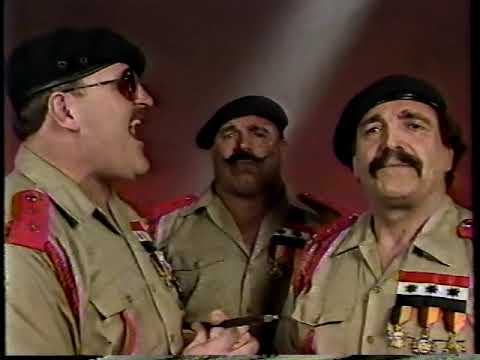
Sgt. Slaughter, Col. Mustafa & Gen. Adnan Promo [1991-04-06]
Wrestling fans, known for their deep understanding of geopolitics and world affairs, took the story in stride by threatening Slaughter with, well, manslaughter. For real, the guy got death threats, and WWE had to tighten up security for the guy. And of course, they also had to call for someone to stand up and defend America’s honor in the ring.
Enter the Hulkster.
Hogan, who was the dominant name in wrestling, had recently seen his star status challenged by fellow superstars Randy “Macho Man” Savage and the Ultimate Warrior. While still a big draw, he had not been in contention for the title and had been relegated to other events, such as the Royal Rumble. But at the 1991 Royal Rumble, which took place days after the Gulf War shifted from Desert Shield to Desert Storm, WWE saw its opportunity and took it. Slaughter shocked the world and won the belt from the Ultimate Warrior.
In an interview after winning the Royal Rumble, Hogan revealed that he “saw” Slaughter and Adnan desecrate the American flag backstage and decided that he had to “fight for the right of every man,” (if they were American, of course). He then proceeded to challenge Slaughter to the mother of all wrestling matches at WrestleMania.
Hogan even guaranteed that his beating Slaughter would ensure the end of the Gulf War.
Of course, the Gulf War ended relatively quickly, but Hogan still had to avenge America’s honor (forget that back then it was pretty hard to change character arcs so quickly). So the match went on.
WrestleMania VII was supposed to be at the massive 100,000 Los Angeles Colosseum but was moved to the smaller 16,000-seat Los Angeles Sports Arena. WWE officials said it was because of the security threats to Slaughter, but in all likelihood, it was poor ticket sales.
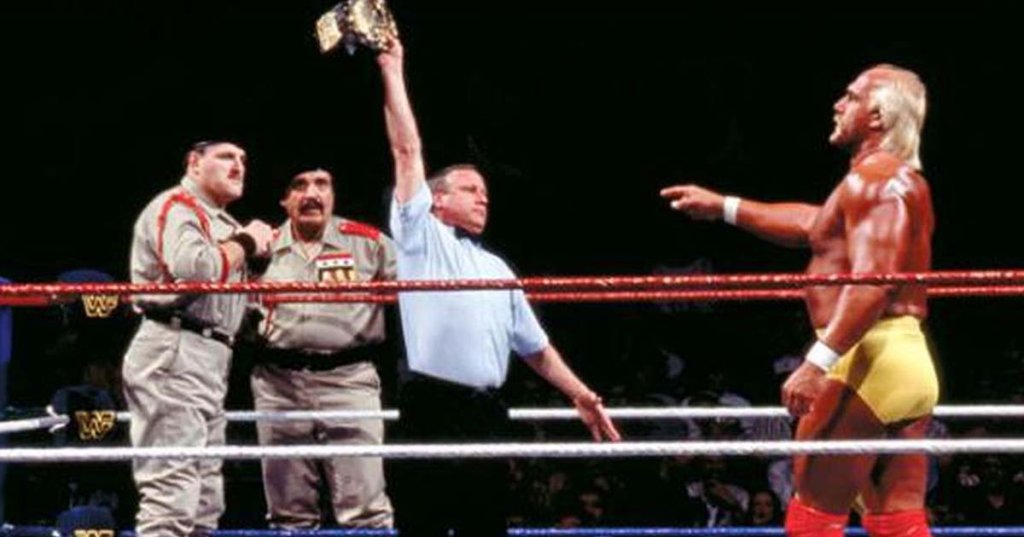
But the smaller crowd, got their money’s worth. Marla Maples, the future second and ex-wife of now-President Donald Trump, was the guest timekeeper. Slaughter, accompanied by Adnan, entered brandishing the Iraqi flag. Hulk Hogan entered with Old Glory, to a thunderous ovation. The match went back and forth with pins, submission holds, steel chairs, manager interference, referee incompetence, and more steel chairs.
Finally, Slaughter got Hogan down and proceeded to retrieve his Iraqi flag. He placed it on Hogan’s body and pinned him. Of course, you know what happens next. The kick out, the hulking up, the big boot, and the pin. As “Real American” played and Hogan won the belt, he hoisted up the flag and celebrated as if he had won the actual war.

Hulk Hogan & Sgt. Slaughter watch their WrestleMania VII main event: WWE Playback
Slaughter would later team up with Colonel Mustafa (who was formerly “the Iron Sheik”) and form the “Triangle of Terror” (which sounds so much cooler than “Axis of Evil”), but the Iraqi angle quickly fizzled out.
Hogan, on the other hand, regained his spot at the apex of sports entertainment and added another memorable moment to a legendary career.