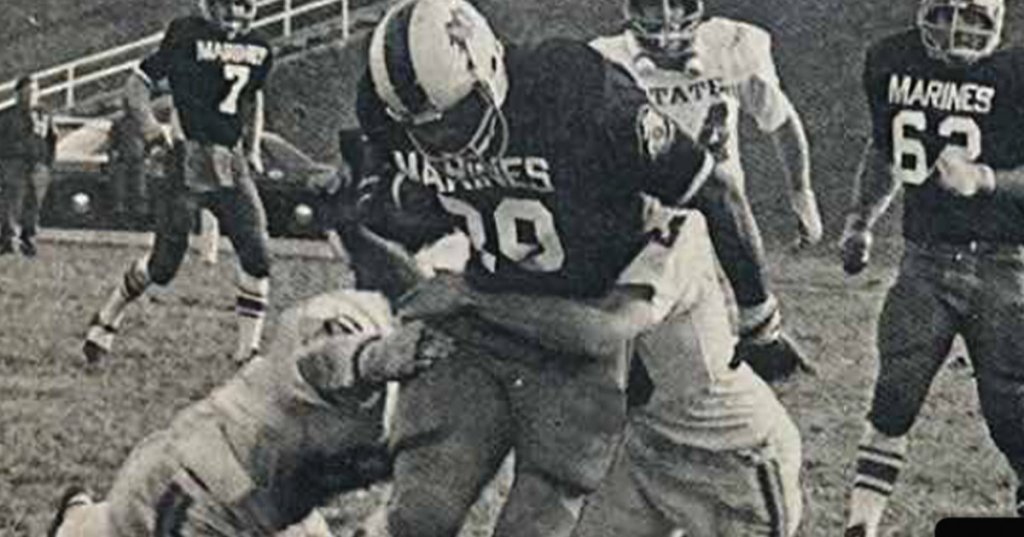
It’s Saturday, Nov. 18, 1972. The weather’s crisp, the stands at Smedley Butler Stadium are packed, and the Quantico Marines football team is down by three against South Dakota State. Two minutes left—96 yards to go.
The Leathernecks grind their way up the field. With 13 seconds left, quarterback Mike Jay spots his receiver wide open in the end zone. This could be the walk-off win that seals more than 50 years of Marine Corps football tradition. Then reality delivers a linebacker named Ken Jones, who crushes Jay before he can let it fly.
The clock hits 0:00. Just like that, the Marines’ final home game is history.
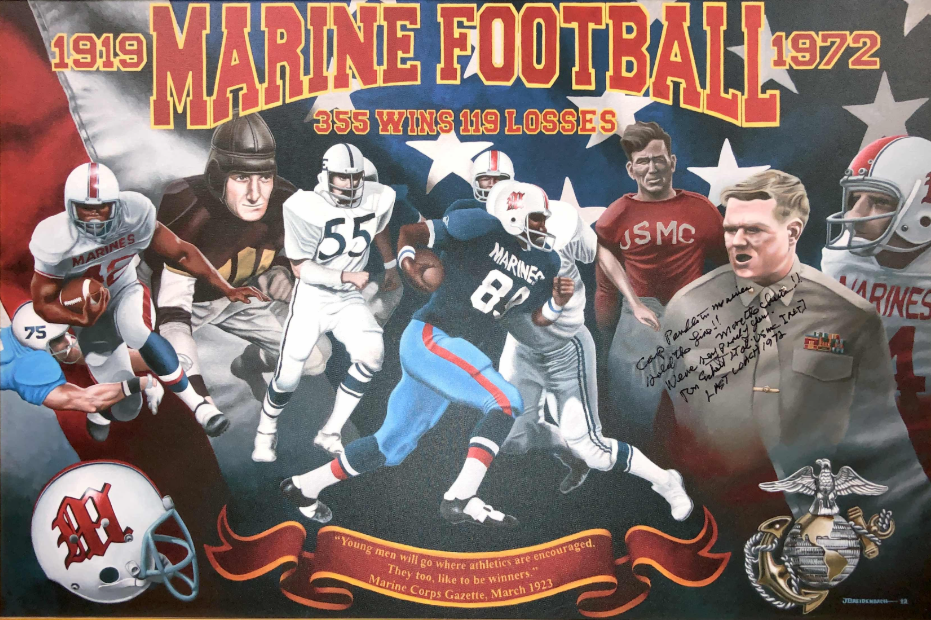
They’d play one more on Thanksgiving Day, shutting out Xavier University 34–0. That win ended the Marines–Xavier rivalry at 13–13. But in Quantico, the locker room was silent. A reporter asked a player how he felt about the Navy Department’s decision to disband the program. His answer was blunt:
“It’s a big mistake… It does a lot of good. It has that masculine image. One thing that draws people who are intelligent and a real asset to the Marine Corps.”
One coach, still in Dress Blues, left a note on the chalkboard anyway:
Workout.
Sunday.
1200.
Because Marines don’t stop. Even when the Corps pulls the plug.
Coach Eckert’s View
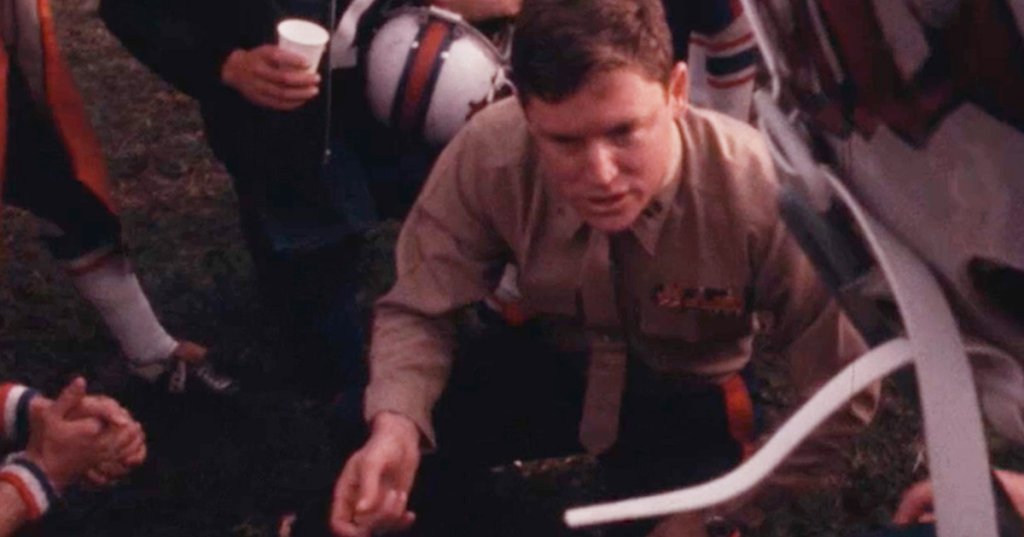
The Quantico Marines’ last coach, Lt. Col. (ret.) Ron Eckert, shared his insight and perspective on the team’s final days with We Are The Mighty.
“I was a freshman at Upsala College in New Jersey in 1958,” Eckert said of his first experience seeing the team. “I heard that the Quantico Marines were going to be playing Rutgers, so I hitchhiked from East Orange, New Jersey, to see the Marines beat Rutgers. The next day, I went to the recruiting station and signed up.”
Twelve years later, he was the head coach.
The talent pipeline was classic Marine Corps: a mix of Vietnam vets still recovering from wounds, brand-new lieutenants from OCS, and fleet Marines pulled in from around the world on permissive orders. The Commandant himself sent out letters encouraging bases to release talent for tryouts.
Mike Jay — the quarterback sacked in that last home game — was a lance corporal recruited from Camp Pendleton. He’d later start at Texas A&M, lead the Aggies to a 10–1 record, and take them to the Liberty Bowl. Not bad for a Marine who once had to balance football with a field day.
But unlike college athletes, Marines also had to pull regular duty.
“Our world changed dramatically; the penchant for service football dried up,” Eckert recalled. “The program was growing and even had an offer to play Syracuse University in the fall opener of the 1973 season. But the growing requirements also meant that more support would be needed, support that was deemed as financially unviable by the Marine Corps.”
Eckert eventually retired and worked as a consultant for the Washington Redskins, but the team he loved never returned. Butler Stadium still stands, now turf-covered and home to combat fitness tests, intramural leagues, and Quantico High School’s football team. But in its heyday, it hosted a program that punched above its weight against college giants.
Devil Dogs on the Gridiron
Marine Corps football first kicked off in 1917 at Mare Island, California. The first squad didn’t just play — it dominated, going 7–0 and allowing only two points all season. They capped it off with a Rose Bowl win on New Year’s Day 1918, before most of the Marines shipped off to World War I.
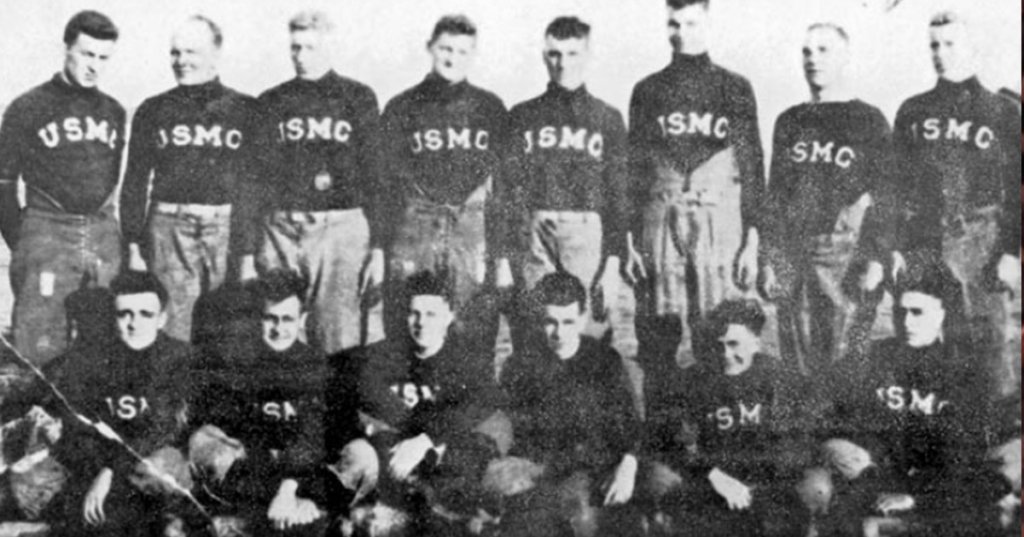
By 1919, Quantico became the team’s permanent home. Through the 1920s and 1930s, they squared off against college programs like Georgetown and Vanderbilt, as well as military outfits, firefighters, and professional clubs. They attracted top athletes, many of whom went on to serve in combat. One Marine standout, Harold “Indian Joe” Bauer, would earn the Medal of Honor posthumously during World War II.
The roster also included names that later became famous on Sundays: Eddie LeBaron, Weldon Humble, Ed Sharkey, Jim Mora (future head coach of the Saints and Colts). Even Bill Cosby — then a Navy corpsman — worked as an athletic trainer for the team.
All told, Quantico football racked up 355 wins over 54 seasons. They weren’t just playing games; they were embodying the Marine Corps’ toughness, teamwork, and grit.
Leatherneck Legacy
The program died in 1972 as the Corps adjusted to the post-Vietnam, all-volunteer era. Recruiting dollars were tight. Priorities shifted. The lessons of Marine Corps football are the same lessons that we try to impart on young Americans today.
Young people want to be where the winning is. The grit and glory of sports in the military represent something greater than what we see on the field; they represent competition. Pushing young people to be better, work together, and bring pride to themselves and their organizations are precisely the lessons we are trying to instill in young people today as the Department of Defense recovers from years of recruiting shortfalls.
Capt. Mike Pitts wrote in The Quantico Sentry at the time that the team showed the “toughness of the Corps,” along with the “teamwork, esprit, and dedication to purpose that have become synonymous with the word ‘Marine.’”
Sports editor for The Manassas Journal, John Horshok, put it even more plainly in 1972: “They are a terrific public relations unit that extends to the very heart of the areas where their presence is most severely criticized – to the college campuses.”
That’s the point. The Quantico Marines weren’t just a football team. They were a recruiting tool, a PR powerhouse, and a living demonstration of what young Americans could become if they joined the Corps.
Today, only the service academies still field NCAA football teams. But once upon a time, the Marines had their own. Maybe someday Butler Stadium will host a Marine team again. Until then, we remember the grit, the glory, and the last chalkboard order:
Workout. Sunday. 1200.