While the world’s major powers are locked in an arms race to develop the best and most advanced hypersonic weapons—basically missiles capable of flying faster than Mach 5 and are thus able to defeat missile defense systems and radars—the Defense Advanced Research Projects Agency (DARPA) has been flying at these speeds for more than a decade.
The history of hypersonics goes back much, much further than the 21st century. Nazi Germany’s V-2 rockets were able to reach speeds of Mach 4.3 after takeoff, but when they struck targets, they often exceeded Mach 5. By 1949, the United States had adopted German rocket technology, which allowed rockets to exceed Mach 5 on takeoff for the first time.
Through this development, the U.S. was able to build its intercontinental ballistic missile arsenal, all of which were capable of speeds above Mach 5 upon reentry. It wasn’t until 1980 that hypersonic research began to focus on glide maneuvering and carrying people.
This led to the creation of the X-15 rocket plane, a manned craft that could reach those speeds but was launched from a B-52 “mother ship.” An X-15 still holds the official world record for the highest speed ever recorded by a crewed, powered aircraft when it reached Mach 6.7 in 1967.
North American’s X-15 led to the development of the Space Shuttle program and the Maneuvering Reentry Vehicle (MaRV) nuclear warhead, which could change its flight pattern at hypersonic speeds. Next came a joint Russian-American hypersonic project, the Kholod, in 1998. Kholod was among the first scramjet experiments, an engine that ignited fuel while already at supersonic speeds. When its fuel ignited, it could push a vehicle to hypersonic speed.
Around 2010, DARPA kicked hypersonic research into high gear. The agency sought to further develop the technologies surrounding hypersonic flight in order to make long-duration, manned hypersonic flights a reality. The result was the Falcon HTV-2, an unmanned, rocket-launched, maneuverable aircraft capable of navigating the atmosphere at speeds of up to Mach 22.
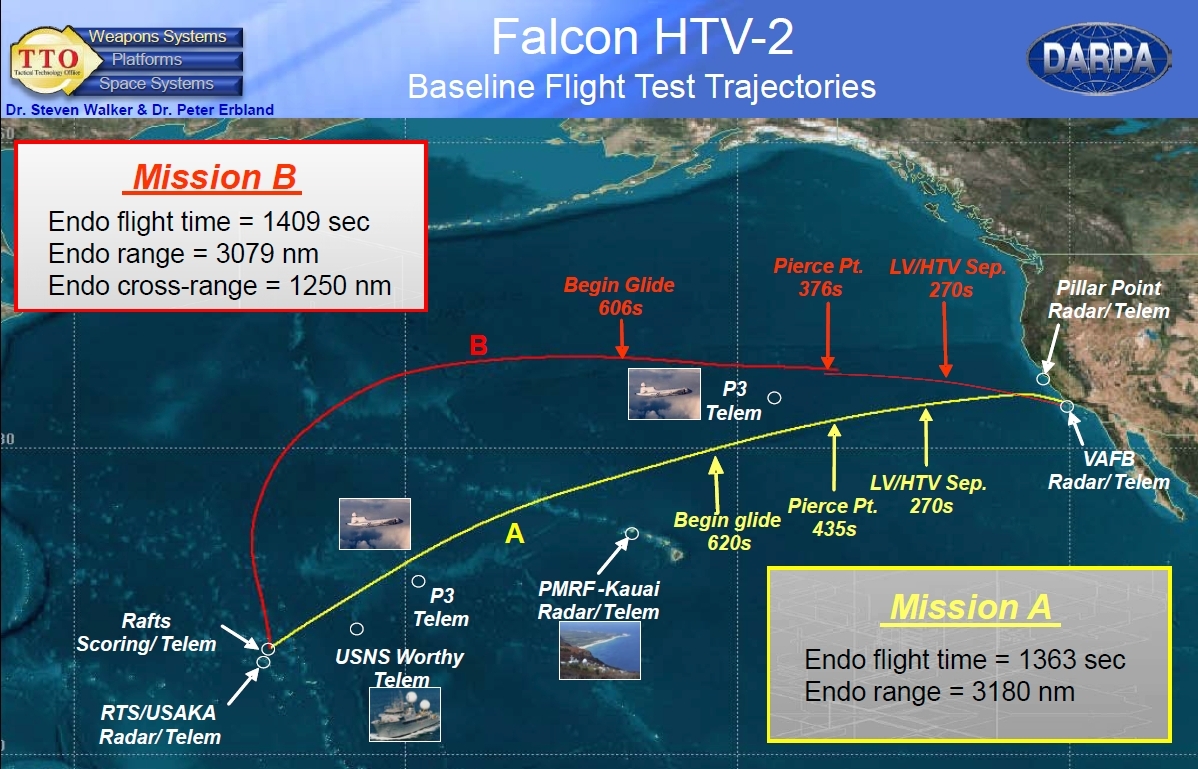
As things stood then (and still do today), the dangers associated with that kind of speed preclude a human from riding in the HTV-2. Instead, the aircraft was equipped with sensors and data collection software to gather information about aerodynamics and aerothermal effects during testing of critical guidance, navigation, and control systems. A Falcon flight didn’t give DARPA much time to collect that data: its max speed could cover the distance between New York and Los Angeles in 12 minutes.
On April 22, 2010, DARPA launched the first flight of the Falcon HTV-2, a flight that lasted nine minutes in all, including 139 seconds of speeds between Mach 17 and Mach 22. The test successfully maintained the craft’s contact with the Global Positioning System, despite traveling at 3.6 miles per second, and kept it in constant two-way communication with the vehicle. Additionally, it effectively utilized its reaction control system.
That maiden voyage deployed the largest number of sea, land, air, and space data collection assets in support of a hypersonic flight test ever. It was so successful that DARPA planned two more flights for 2011. When another test finally came in October 2011, the aircraft was lost nine minutes into the flight. The velocity of Mach 20 ripped off the Falcon’s protective coating, but testing didn’t stop.
In 2018, Russian President Vladimir Putin announced Russia had created the first operational hypersonic weapon, the Avangard missile, capable of speeds between Mach 20-27. It has since claimed to use them against enemy forces in Ukraine. This has kicked the U.S. hypersonic missile programs into high gear, with the first one, the Air Force’s AGM-183A, also known as the Air-Launched Rapid Response Weapon (ARRW), scheduled for deployment in 2025.
So while it may seem that the United States is woefully behind in hypersonic weapons research and development, the truth is that if the Pentagon had wanted these weapons, it could have created them as far back as the 1990s.