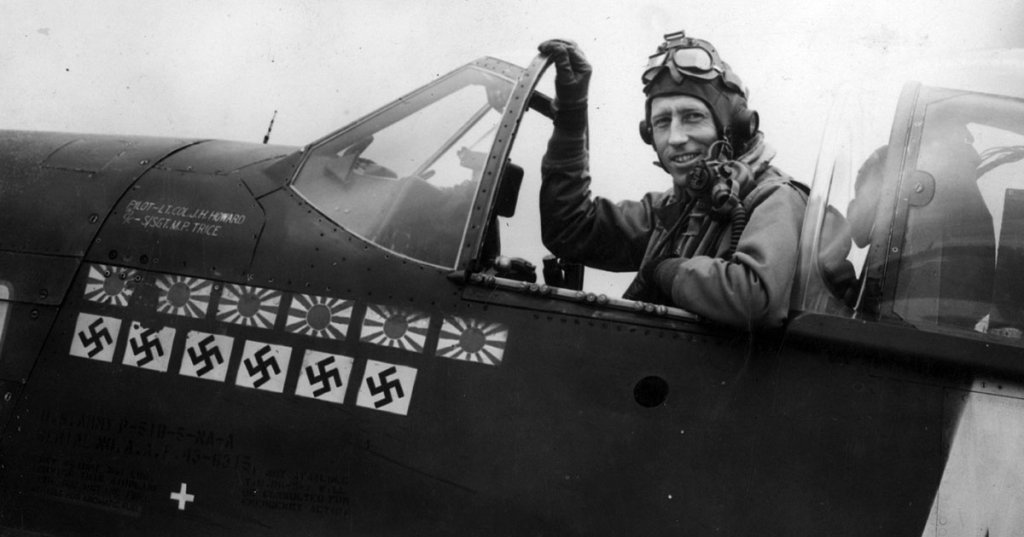
James Howard started his World War II combat career before the United States ever entered the war. He would end the war with a Medal of Honor and the nickname: the “One Man Air Force.” He was a naval aviator who flew with the Flying Tigers, then joined the Army Air Forces, where he became an ace in two different aircraft in two different theaters. He would eventually retire as a Brigadier General—quite an impressive bucket list.
Also Read: A pilot survived a Mach 3 ejection from the edge of space by not ejecting at all
But the story of how James Howard became the “One Man Air Force” starts far from American shores.
He was born in Canton, China, where his American father, an ophthalmologist, taught eye surgery. When the family returned to the United States in 1927, Howard set out on his own medical track—until the romance of flight got to him. In 1937, he joined the Navy, earned his wings at Naval Air Station Pensacola, and flew from the deck of the USS Enterprise as a commissioned Navy naval aviator.
Meanwhile, trouble was brewing abroad, especially in China, where he spent much of his youth. In mid-1941, Howard resigned his Navy commission to join Claire Chennault’s American Volunteer Group (AVG), more popularly known as the Flying Tigers, in the far east.
Howard was assigned to the AVG’s 2nd Pursuit Squadron, the Panda Bears, operating from Burma and Thailand in Curtiss P-40 Tomahawks. In early January 1942, during a strike near Raheng, Thailand, he got his first aerial victories, destroying three Japanese Ki-27s on the ground while his wingman, Tex Hill, kept his tail clear and claimed another in the air.
Howard added more victories that month and scored his final AVG kill on July 4, 1942—the same day the Flying Tigers were disbanded. By then, he’d flown 56 combat missions in the theater and was credited with six victories in the P-40.
After the AVG, Howard returned stateside and entered the U.S. Army Air Forces. Promoted to major in 1943, he took command of the 356th Fighter Squadron in the 354th Fighter Group. It was the first to take the Merlin-powered P-51B into combat. They moved to RAF Boxted in the fall of 1943, just weeks after “Black Thursday,” the bloody second Schweinfurt raid, and began pushing deep into German airspace. Since they were the first pilots to fly the new fighter in combat, and so deep inside Germany, they started calling themselves the “Pioneer Mustang Group.”
The new Mustang carried four .50-caliber machine guns and, with external tanks, could range farther than earlier escorts; its top speed was more than 425 mph, depending on altitude and engine settings. It wasn’t magic—combat radius was still finite and weather could undo the best plans—but it finally gave Eighth Air Force bombers a fighter that could fight deep and fight well.
Gallantry Over Oschersleben
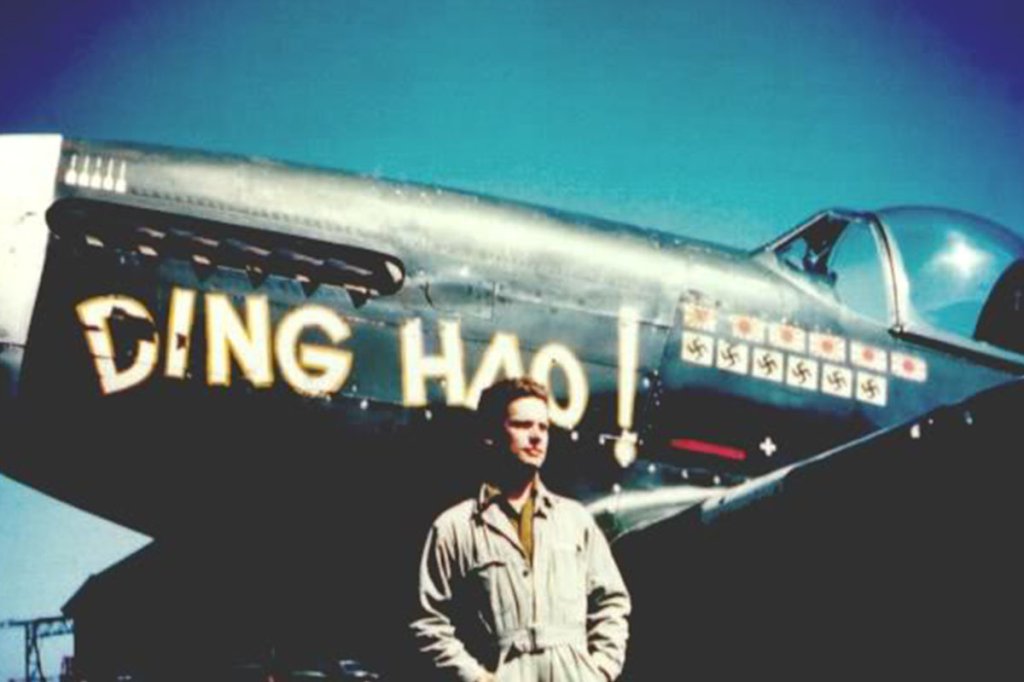
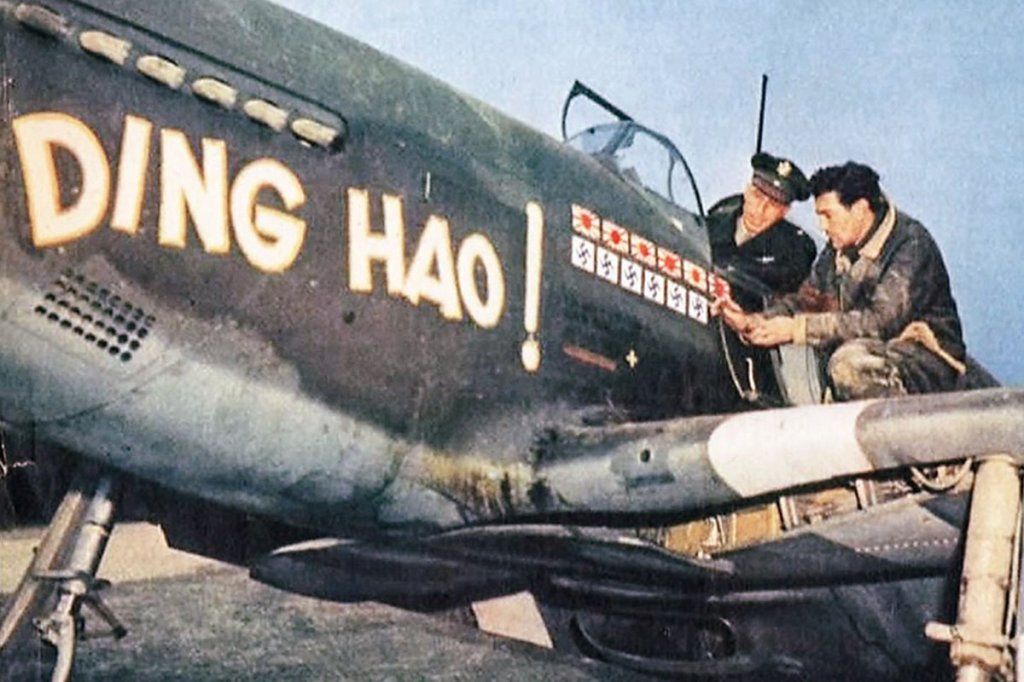
On January 11, 1944, the Mighty Eighth launched a large strike package against multiple targets, including the AGO factory at Oschersleben, a key producer of the Fw 190—weather scattered parts of the force and escorts; some formations pressed on into a hornet’s nest. Howard led elements of the 354th into the fight in his personal P-51B, “Ding Hao!,” coded AJ-A. It would be the biggest operation since the Schweinfurt raid three months earlier and the first mission under their new commander, Gen. Jimmy Doolittle.
The Luftwaffe was savaging the bombers as the Pioneer Mustangs reached the target, and the P-47s were heading back to base because they were low on fuel. Groups of four, twelve, and thirty Fw 190s were wreaking havoc.
When the bombers came into view, Howard cut straight into the swarm. He pounced on a twin-engine Me 110 lining up a B-17, hammered it until it broke away and went down, then raked a Bf 109 that trailed smoke into a descent. A moment later, an Fw 190 flashed across his nose; Howard hauled his Mustang into a climbing, turning chandelle and closed so aggressively the German pilot bailed out rather than risk the collision and the guns.
Howard stayed at it for roughly half an hour, repeatedly breaking up attacks, and when his ammunition finally ran dry, he kept making threatening passes to scatter the next wave. Bomber crews watched the show in disbelief. One formation leader, Maj. Allison Brooks, later said that for sheer nerve and persistence, he’d never seen anything like it—one fighter pilot ranging across the front of the formation, spoiling attack after attack as if the whole job were his alone.
The day was costly. Losses among the bombers were heavy at Oschersleben and across the broader mission, and the Luftwaffe paid dearly as well. When the tallies were sorted and the gun-camera film reviewed, Howard was officially credited with destroying three enemy aircraft on January 11. He had already scored one victory in Europe in December and would become an ace in the European theater on January 30, while he was already an AVG ace from the earlier campaign in Asia.
The tale of an “unknown Mustang pilot” guarding the bombers raced through the press, but it didn’t stay unknown for long. Headquarters identified Major James H. Howard, commander of the 356th, as the man in AJ-A, “Ding Hao!”
While Howard’s rampage was ongoing, the bomber crews looked on.
“For sheer determination and guts, it was the greatest exhibition I’ve ever seen,” Brooks said. “It was a case of one lone American against what seemed to be the entire Luftwaffe. He was all over the wing, across it, and around it. They can’t give that boy a big enough reward.”
When the battle was over, the U.S. lost 37 heavy bombers and five fighters, while the Luftwaffe suffered 15 losses, eight probable losses, and 16 damaged aircraft.
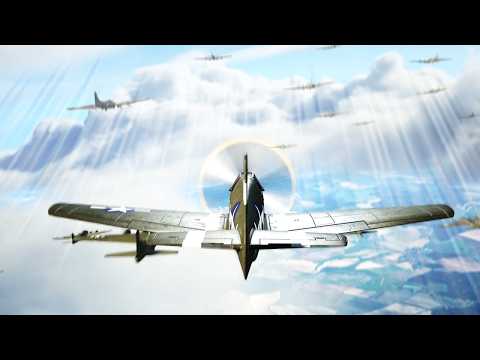
The One Man Airforce
By morning, Howard’s story had reached headquarters, and Gen. Doolittle wanted to know the name of the pilot who had placed himself between the bombers and a force of more than thirty enemy aircraft. An investigation was launched to find the pilot of the plane, coded only as AJ-X, until James Howard was found. The U.S. needed some positive publicity after the disastrous Schweinfurt raid.
In June 1944, in London, Lt. Gen. Carl Spaatz presented Howard with the Medal of Honor for his actions that day. He remains the only Eighth Air Force fighter pilot to receive the nation’s highest award. It was the punctuation mark on a career that bridged two services, two theaters, and two legendary fighters.
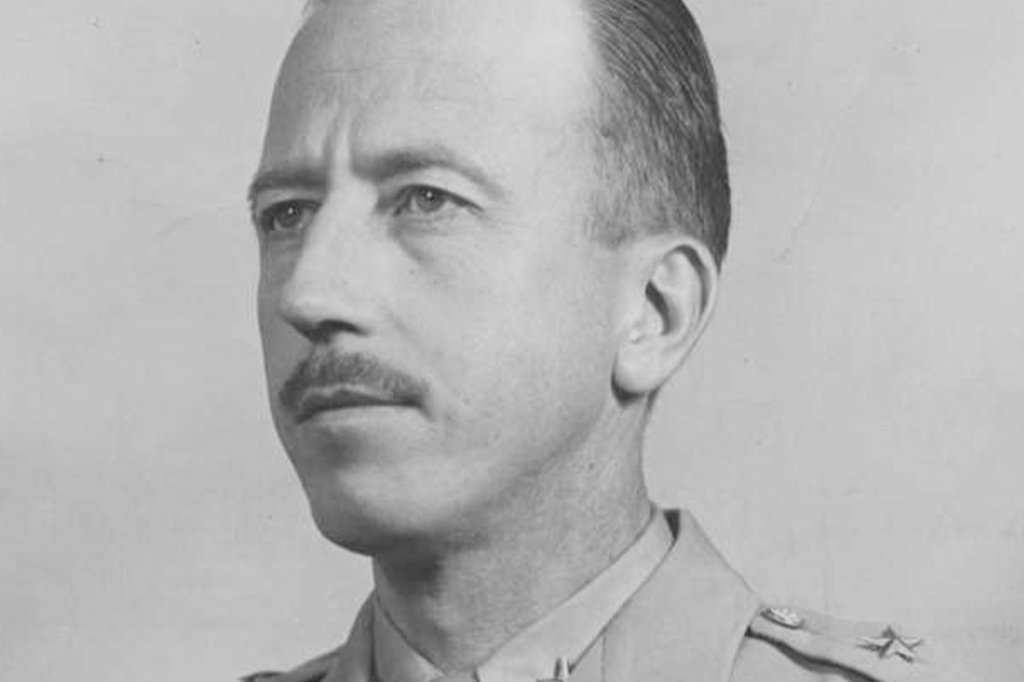
After the war, Howard was promoted to full colonel on Nov. 25, 1945, and soon after left active duty, remaining in the newly formed U.S. Air Force Reserve. He served as base commander at Pinellas Army Air Field—today’s St. Petersburg–Clearwater International Airport—and was promoted to brigadier general on March 22, 1948. He retired from the Air Force on Oct. 1, 1966.
General James H. Howard died on March 18, 1995, a time when the story of the “One Man Air Force” still echoed among surviving World War II bomber crews. He was laid to rest at Arlington National Cemetery.