It’s safe to say that the vast majority of troops and veterans today have seen the 1997 film, “Starship Troopers.” It’s an expertly crafted film, and its tasteful use of special effects (for the late 1990s, anyway) was beyond astounding.
Related: ‘Starship Troopers’ is (finally) getting a reboot—here’s what could be different
The film is terrific in its own right, but Robert A. Heinlein’s novel, upon which the movie is (loosely) based, elevated the science fiction genre and has a place on nearly every single required reading list created by the United States military. If you’re a young private in the Marines or a battalion commander in the Army, you will be asked to read this classic—and this is why.
Technically speaking, the film was originally based on an unrelated script for a film called “Bug Hunt at Outpost Nine” until the production team realized that it bore only a passing resemblance to the novel. This led to many of the significant differences between the two, as well as a drastic change of tone.
The adaptation of the original script to film made a stronger statement about how propaganda affects troops fighting in a war, in a satirical manner. The novel, however, uses the Bugs as a stand-in for a nameless enemy to focus on the theme of a soldier’s mindset fighting a seemingly unstoppable force.
This is immediately made clear in the first paragraph of the novel.
“I always get the shakes before a drop. I’ve had the injections, of course, and hypnotic preparation, and it stands to reason that I can’t really be afraid. The ship’s psychiatrist has checked my brain waves and asked me silly questions while I was asleep and he tells me that it isn’t fear, it isn’t anything important—it’s just like the trembling of an eager race horse in the starting gate. I couldn’t say about that; I’ve never been a race horse. But the fact is: I’m scared silly, every time.”
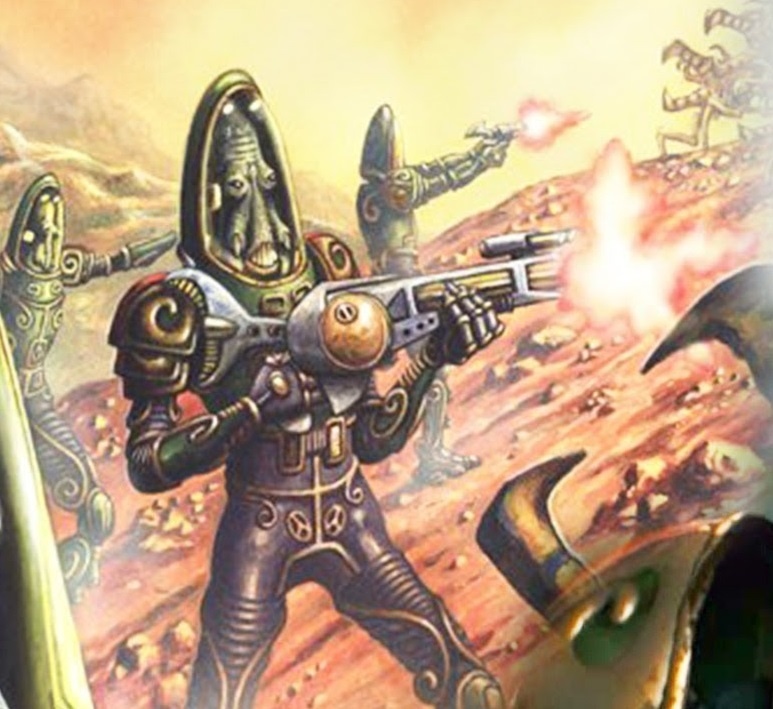
Contrary to what you’d expect if you’ve only watched the film, they’re actually fighting a different alien than the Arachnids (at first.) The first enemies were called “skinnies” and were essentially tall, lanky, human-like aliens who posed little threat to humans. Their entire Army is easily wiped out by just a single platoon, but the prospect of war still frightened Johnny Rico, the story’s protagonist.

After the battle, the story flashes back to Rico’s time as a civilian before the Mobile Infantry. The idea of “service equals citizenship” had a different meaning in the novel. Despite the world being under the unified “Terran Federation,” the military and its veterans were treated as a higher caste than non-military people. You literally had to join the military to become a citizen.
This hyperbole was just as relevant in 1950s society (as it is today in the military community). Even though signing up is a fantastic way to get benefits in our world, and definitely in the novel’s world, military service is often discouraged and looked down on, as demonstrated by Rico’s father (initially, anyway).
The novel spends a lot of time in the Mobile Infantry’s boot camp. It shows the deeper motivations about what it takes to be in the military—mainly the forced brotherhood, the “one team, one fight” mentality, and the loss of personal identity that comes with service. This eventually leads to the “Bug War,” when the Arachnids destroy Rico’s home city, Buenos Aires.
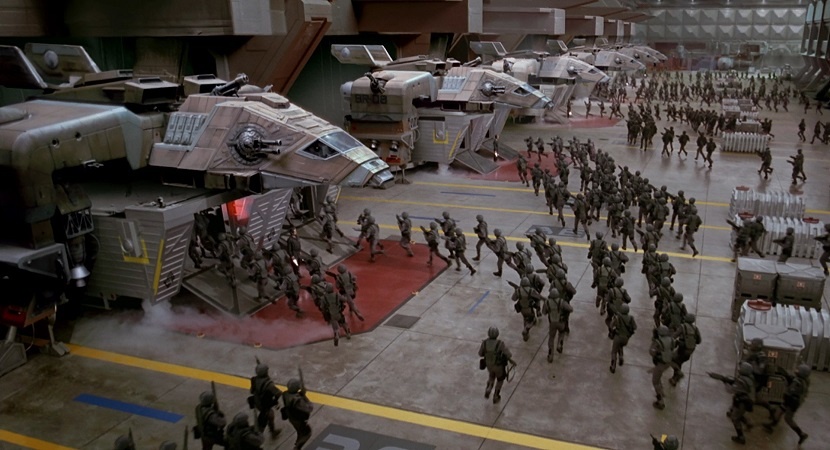
The troops are overzealous and believe they can handle it. Despite Rico being the only one personally affected by the attack, he’s also one of the few not to refer to the Arachnids as “bugs,” which was strongly implied to have racial undertones. He instead keeps a level facade while remaining terrified. The first chapter happens around here. This is the exact mindset of many troops right before they’re deployed.
When the Mobile Infantry arrives on Klendathu, it’s a complete disaster—the exact opposite of the battle with the skinnies. The Arachnids were massive, and though the humans had the firepower, it was no match for the unstoppable numbers of their enemy.
Rico finally gets his chance to fight the Arachnids with Rasczak’s Roughnecks. He and his men capture a Brain Bug and begin learning more about the “bug” society. It mirrored their own, except the Warriors were the lowest caste fighting for an apathetic queen. Rico learns that aimlessly tossing troops at the problem would only result in more and more deaths.
The novel ends with a coda of the first chapter as Rico is about to make his drop onto Klendathu with confidence. He does this because he learned the value of military strategy—the one thing the Arachnids lacked.
“Starship Troopers” makes heavy parallels between the Mobile Infantry and Arachnids. It’s often incorrectly believed by casual readers, or those without knowledge of the military, that the novel promotes fascism and militarism, but it doesn’t.
If anything, the novel explores the troops’ psyches as they head into combat, but it just uses an extreme science fiction setting to do so.