
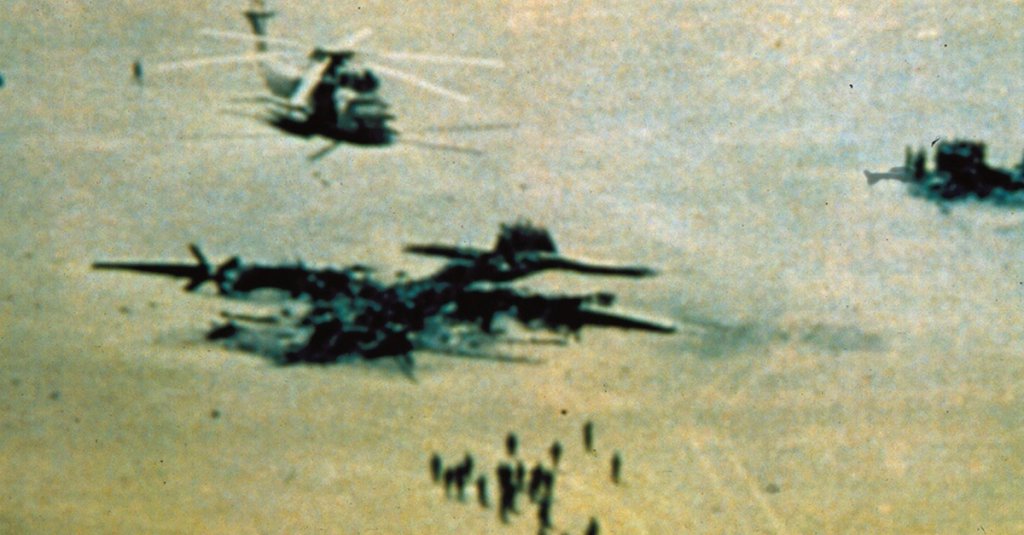
In April 1980, two CIA officers flew Maj. John T. Carney Jr., a U.S. Air Force Combat Controller, to a small strip of road in the South Khorasan Province, Iran. This location would live in special operations infamy forever, by its code name: Desert One.
Major Carney installed infrared lights, a strobe for use as landing lights, and tested the ground, which was hard-packed sand. By this time, Iranian students had already held 52 American diplomats and other embassy personnel hostage for 149 days.
The U.S. military was determined to get them out.
Also Read: What British civilians did for special operators after ‘Desert One’ will tear you up
This final, very complex mission was supposed to take two nights. Led by Delta Force founder Col. Charles Beckwith, it called for coordination between elements from the Army Rangers, Air Force, Navy, and CIA operatives.
The plan was divided into multiple phases to minimize detection and maximize surprise, beginning with the deployment of six C-130 Hercules transport aircraft and eight RH-53D Sea Stallion helicopters from the USS Nimitz in the Arabian Sea. The helicopters, chosen for their long-range capabilities but modified from Marine Corps mine-sweeping variants, were to fly low to avoid radar detection and rendezvous with the C-130s at a remote desert landing site in southeastern Iran, designated Desert One.
This site, selected via satellite imagery and CIA reconnaissance, was a flat, uninhabited area about 200 miles from Tehran, where the helicopters would refuel from fuel bladders carried by the C-130s.
Colonel James Kyle, commanding officer at Desert One and planner for Eagle Claw, called it “the most colossal episode of hope, despair, and tragedy I had experienced in nearly three decades of military service.” It would also lead to the complete reorganization of American special operations.
Desert One: The Plan
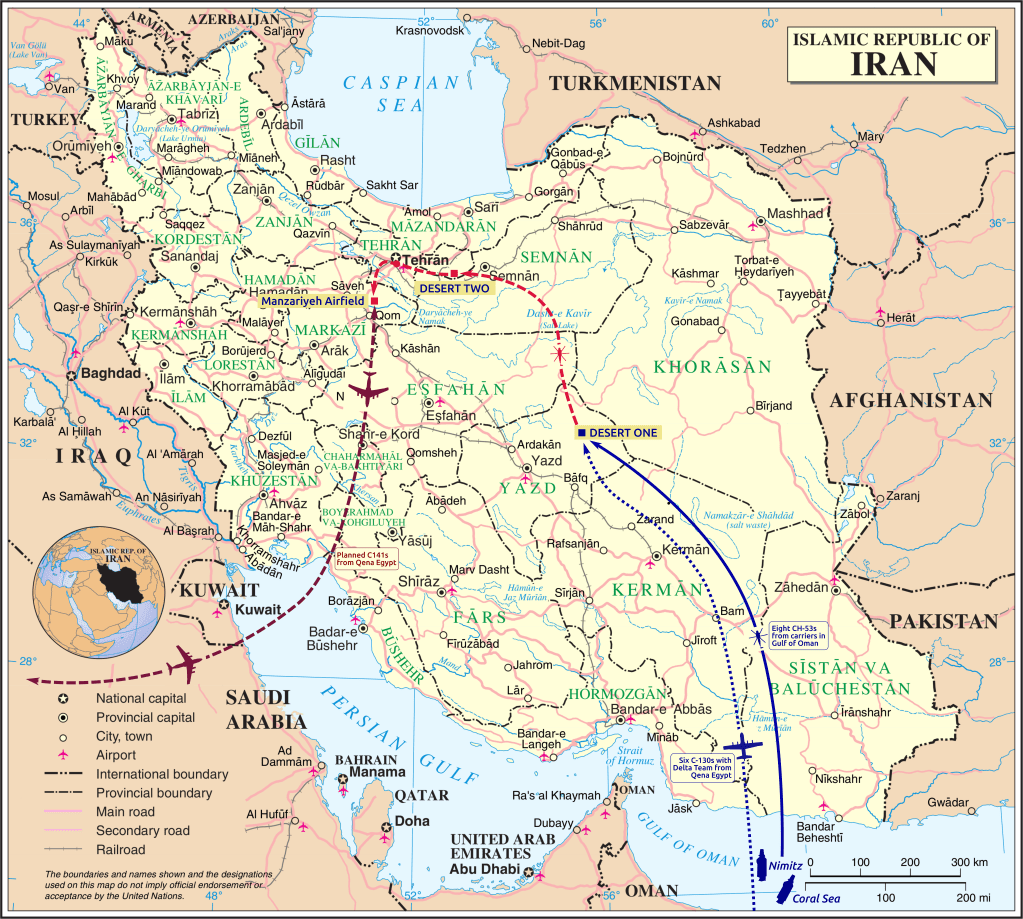
On the first night, three Air Force C-130s would bring 6,000 gallons of fuel in bladders to Desert One. Once refueled and consolidated at Desert One, the force of 120 Delta Force operators, support personnel, and interpreters, would board the helicopters and fly to a second hideout. Designated Desert Two, it was a mountainous area about 65 miles southeast of Tehran. There, the team would conceal themselves and the helicopters under camouflage netting during daylight hours to evade Iranian patrols.
CIA operatives already in Tehran pre-staged vehicles, including trucks disguised as local commercial vehicles, which would transport the rescuers into the city under cover of darkness, from the Southern coast of the Gulf of Oman on the second night. The assault phase involved splitting into teams: a main force would storm the U.S. Embassy compound to free the majority of hostages, while a smaller team would raid the Iranian Foreign Ministry to rescue three diplomats held there.
The plan accounted for potential resistance by incorporating suppressed weapons, night-vision goggles, and detailed intelligence on guard positions and hostage locations, gathered through smuggled sources and defectors.
After securing the hostages, the rescuers planned to move them to a nearby soccer stadium or, as a backup, Manzariyeh Airfield about 35 miles south of Tehran, which would be seized and secured by a company of Army Rangers flown in on additional C-130s. From there, the entire group would be evacuated by C-141 Starlifters to a safe location, likely in Egypt or Oman. The helicopters were to be abandoned or destroyed at Desert Two to avoid leaving evidence.
The operation relied heavily on precise timing, weather conditions, and mechanical reliability, with contingencies for minor setbacks, but a strict minimum of six operational helicopters was required to proceed beyond Desert One. Extensive rehearsals were conducted in the U.S. deserts to simulate the mission’s complexities. It should have been a critical success, but as we all know: the first casualty of war is the plan.
Where Eagle Claw Went Wrong
Failures began almost immediately after the mission was launched on April 24, 1980. American forces, fuel, and supplies were delivered as planned, but everything else became a debacle.
Of the eight helicopters that departed from the Nimitz, two turned back early due to severe mechanical issues: one suffered a cracked rotor blade after encountering an intense sandstorm, called a haboob. Another experienced a malfunction in its bimini indicator, a critical navigation system. This reduced the fleet to six upon arrival at Desert One, barely meeting the minimum threshold. The remaining helicopters arrived scattered and delayed, exacerbated by poor visibility from dust and the lack of reliable navigation aids in the Iranian desert.
Meanwhile, the C-130s landed successfully and began unloading fuel and personnel, but the site proved more exposed than anticipated when a civilian bus and a fuel tanker unexpectedly passed through, forcing the team to detain the bus passengers and destroy the tanker, which created a massive fireball. The Rangers had no idea what to do with a busload of Iranian civilians.
As refueling began, one of the helicopters, maneuvering for takeoff after refueling in a swirl of dust, collided with a parked C-130 aircraft. The impact caused a massive explosion, killing eight American servicemen—five airmen and three Marines—and injuring several others.
The fireball illuminated the desert, destroying both vehicles and scattering debris, which further complicated the situation. With only five helicopters now operational (one more had been deemed unfit due to a hydraulic failure discovered at Desert One), Colonel Beckwith and mission commander Maj. Gen. James Vaught, determined that the mission could not proceed safely, as the plan explicitly required at least six helicopters to transport the full assault team and hostages.
President Carter, monitoring from the White House, approved the abort order, leading to a hasty retreat where the remaining helicopters evacuated personnel back to the C-130s, which then flew out, leaving behind the damaged helicopters and sensitive equipment.
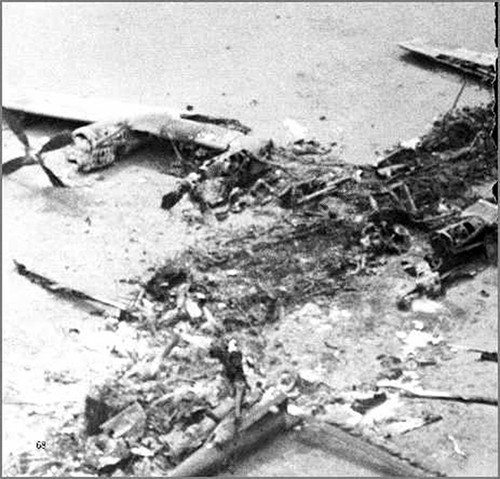
All five remaining helicopters were left on the ground in the subsequent evacuation (two of them are still in active service with the Iranian Navy as of 2017). The bodies of the service members killed at Desert One were found by the Iranians the next day.
Investigations revealed multiple systemic issues: inadequate helicopter selection and maintenance (the RH-53Ds were not ideally suited for long-range desert operations), insufficient pilot training for extreme dust conditions, poor interservice coordination (Navy helicopters and Air Force planes operating under different protocols), and an over-reliance on untested modifications. The mission’s secrecy was also a factor. It limited external expertise and contributed to overlooked risks.
The failure of communications between branches during Eagle Claw is the reason each services’ special operations commands now fall under USSOCOM in 1987, and improved joint special operations training. Further changes in structure resulted after intense scrutiny, research, and a Congressional Committee.
Plans for a second rescue operation continued under the code name Project Honey Badger, but it was too late for President Carter’s reelection hopes. His administration effectively ended with the election of Ronald Reagan and the hostages’ subsequent release on Inauguration Day, 1981. Carter, rather than return home to Georgia, went to greet the hostages as they arrived in Germany.
When asked what he would do differently during his presidency, Carter always remarked, “I would have sent one more helicopter, which would have meant that we could have brought out all the hostages and also the rescue team.”
Today, the former hostages remember with reverence the men who died trying to rescue them.
“While no day hurts more—than today and always—than the day when these brave men lost their lives in an attempt to reach us, no day makes us more proud as well, because of the way in which they stood for that cause of human freedom. For that, all of us (former hostages) will be forever grateful,” said Bruce Laingen, a hostage and former charge d’affaires to the embassy in Iran, about the operation.
The men who died at Desert One:
Capt. Harold L. Lewis Jr., U.S. Air Force
Capt. Lyn D. McIntosh, U.S. Air Force
Capt. Richard L. Bakke, U.S. Air Force
Capt. Charles McMillian, U.S. Air Force
Tech. Sgt. Joel C. Mayo, U.S. Air Force
Staff Sgt. Dewey Johnson, U.S. Marine Corps
Sgt. John D. Harvey, U.S. Marine Corps
Cpl. George N. Homes, U.S. Marine Corps
Their remains were not recovered, but a memorial dedicated to their memory stands in Arlington National Cemetery.

Operation Eagle Claw's anniversary
Don’t Miss the Best of We Are The Mighty
• Aviation nerds are mourning Iran’s F-14 Tomcats
• The humiliating way Israel achieved air superiority in Iran during the 12-Day War
• Midnight Hammer was the second-longest bombing mission
Sponsored Content
‘The Fix’ is an action movie for the post-War on Terror world
Loading comments…
Comments couldn’t be loaded. Please refresh the page.