The plan sounded bold enough to be science fiction: push America’s early-warning radar network dozens of miles into the Atlantic, mount it on platforms that looked like oil rigs, and buy the Air Defense Command extra minutes to spot Soviet bombers before they reached the coast. In the 1950s, those platforms, quickly dubbed the “Texas Towers,” promised eyes over the ocean at a time when minutes mattered.
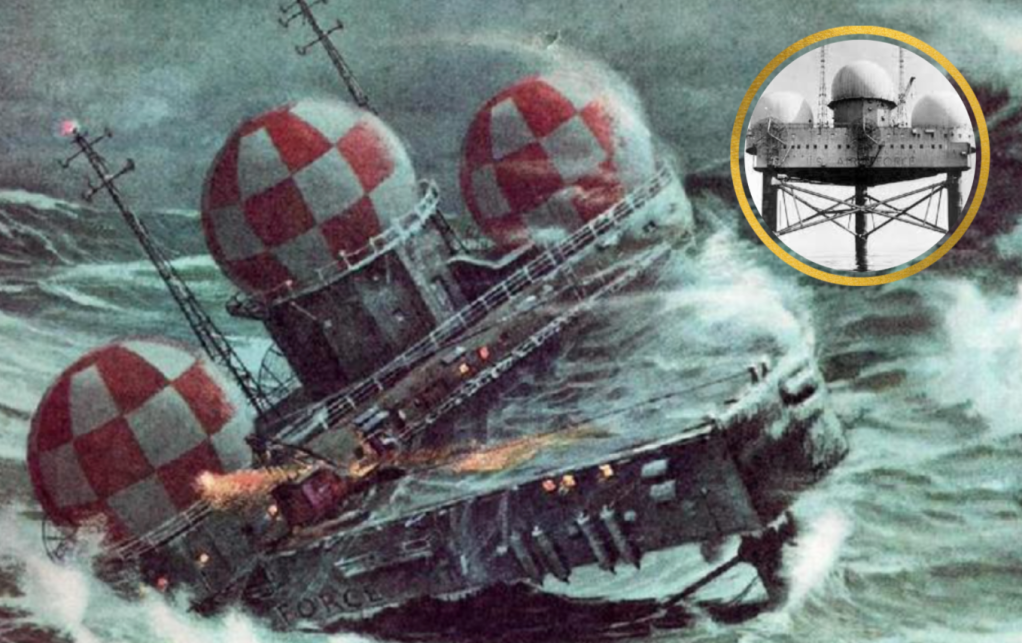
Texas Tower 4 was the most ambitious of the bunch. Planted about 63 miles south-southeast of Long Island in 185 feet of water, it sat deeper and took more brutal punishment than its siblings. The steel legs were braced with a lattice of cross-members, the decks crammed with living quarters, generators, a foghorn that rattled nerves, and the radar gear that justified the whole precarious enterprise.
The crews who lived there called it “Old Shakey,” and the nickname wasn’t cute. The entire structure vibrated, creaked and swayed in a way you felt in your bones.
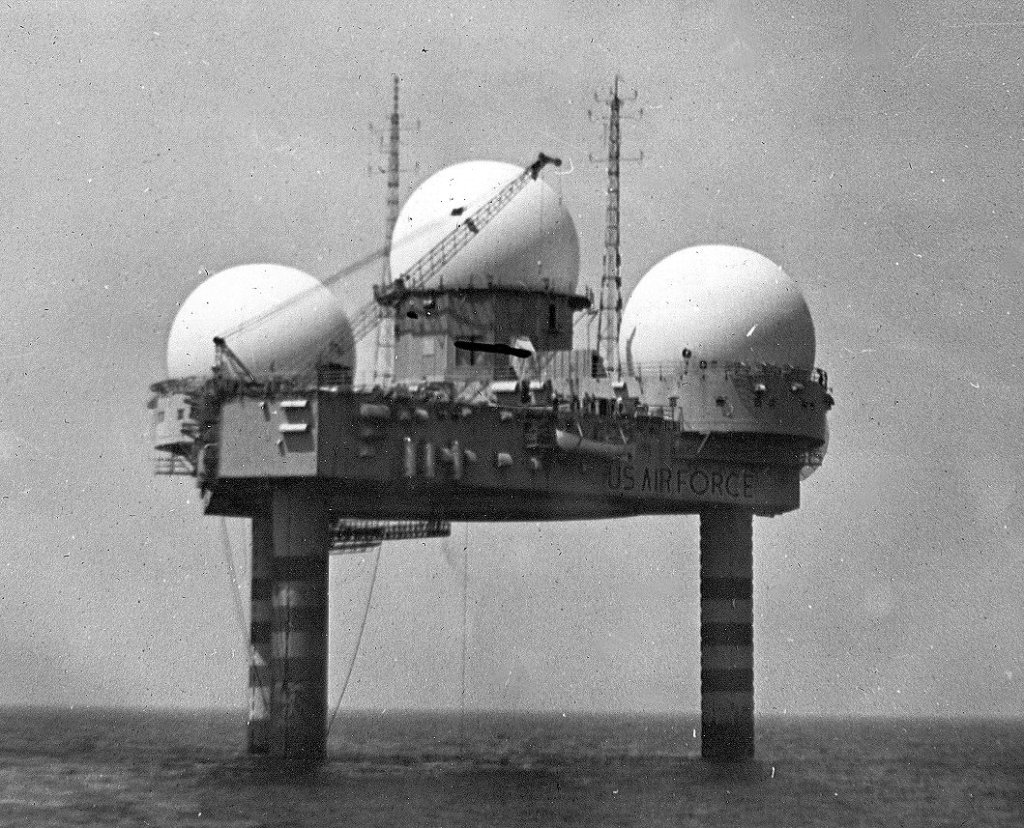
From the start, Tower 4 fought the sea. Braces worked loose during transport. Divers were summoned for repairs. When Hurricane Donna blasted through in September 1960, the damage was bad enough that manning levels were cut and talk shifted from operations to dismantlement. But Cold War logic was relentless: you couldn’t leave it unattended without risking Soviet trawlers boarding to snag classified equipment. So the skeleton crew stayed while plans dragged on.
On January 15, 1961, the North Atlantic served up one of its cruel lessons. A winter storm closed in. Helicopters couldn’t fly. Navy and Coast Guard ships were dispatched, but seas were too heavy to attempt transfer. At 6:45 p.m., a distress call crackled out from the platform: “We’re breaking up.” Minutes later, Texas Tower 4 slipped off radar screens and into the dark. All 28 men aboard—14 Airmen and 14 civilian contractors—were lost. Divers later found twisted steel on the bottom; only two bodies were recovered. A federal court would write it plainly: the tower collapsed at roughly 7:25 p.m. in 185 feet of water, killing everyone aboard.
The horror of that night became the shorthand for everything fragile about the program. The Air Force rebuilt nothing like it again. Texas Towers 2 and 3 were soon closed, their missions absorbed by airborne early-warning aircraft and improved shore-based radar. Offshore steel might stand against drilling mud and gentle seas; the North Atlantic is not gentle, and radar decks are not oil rigs.
Yet the idea behind the towers made grim sense in its moment. In 1954, after MIT’s Lincoln Laboratory studied how to push early warning farther seaward, the U.S. green-lit a fleet of platforms that could extend coverage by hundreds of miles. In an era before reliable intercontinental ballistic missile detection, the main fear was bomber streams arcing over the pole. A half-hour of extra warning could mean scrambled fighters, lit runways and manned missile sites. That urgency explains why crews put up with the noise, the nausea and the swaying that sent coffee sloshing in cups.
What doomed Texas Tower 4 wasn’t one bad bolt or a single unlucky wave. It was design compromises interacting with relentless conditions and a timeline that always seemed to favor “just a little longer” over “get everyone off now.” Multiple investigations would later highlight inadequate emergency procedures and structural vulnerabilities. The commander of the tower, Capt. Gordon “Larry” Phelan, had reportedly pushed to evacuate earlier; authorization came only hours before the platform failed, when rescue was already a dicey proposition. The storm did not care about authorizations.

The Worst Place on Earth to Be Stranded | Texas Tower 4
Even shorn of its classified mystique, the tower’s story still hits a nerve because it’s a perfect Cold War parable. When technology, urgency and the ocean meet, the ocean votes last. The towers bought valuable radar coverage for a few years, but at an awful price. They also nudged the Air Force toward solutions that moved—notably the EC-121 Warning Star aircraft flying from Cape Cod—which could ride above the weather rather than try to out-stiffen it.
For the men who served aboard, life was equal parts monotony and dread. The foghorn bleated, the steel moaned, and the horizon was a flat circle. Mail came by helo or ship. A few photographs show poker games, coffee clubs, and hardy smiles—stubborn human rituals stapled onto a platform that never really stopped quivering. When divers went down in 1963 to survey the wreck of Tower 4, they reported a traveling crane’s broken boom draped over a corner and the surreal geometry of a triangle splayed across the seabed. The ocean had rearranged everything into a new kind of quiet.
The wreckage still rests out there, waves passing overhead without a ripple of memory. On land, small memorials and scattered stories do the remembering. If you trace your finger across a map southeast of Long Island, you can mark the spot where America tried to anchor radar to the seafloor, and the sea proved once again that it has no patience for half-measures.