Americans have been dumping valuable stuff into the ocean since before the United States became an independent country. Whether it was done as a protest, as a disposal method, or out of pure spite. Sometimes it was symbolic. Sometimes it was practical. Sometimes it was both. The area known as “Million Dollar Point” was all three.
Also Read: The John Frum Movement and World War II ‘cargo cults’
But in nearly every case, the result was the same: enormous amounts of goods ended up in the drink. Tea. Weapons. Vehicles. Chemicals. Perfectly usable equipment. Hazardous junk nobody wanted to store. The sea has taken all of it.
Million Dollar Point
After World War II, the U.S. faced a monumental logistics problem across the entire Pacific: getting rid of nine million tons of surplus military material, valued at nearly $4 billion (north of $73 billion today). This massive clean-up operation became known as Operation Roll-Up.
On the island of Espiritu Santo, now in Vanuatu, the problem was particularly visible. The island was a major Allied logistics hub during the war, which meant it was packed with vehicles, machinery, tools, and supplies. When the war ended, the Americans offered to sell much of that gear to French and British authorities at a steep discount, reportedly as low as six to ten cents on the dollar.
They said no.
The likely assumption was that the U.S. wouldn’t bother shipping everything back, so the equipment would eventually be left behind anyway. That was a reasonable guess. It was also wrong.
The Americans dumped it.
For days, troops pushed trucks, bulldozers, machinery, supplies, and other equipment into the sea. In many cases, the equipment was perfectly usable. The message was straightforward: if the Allies wouldn’t buy it, they weren’t getting it for free. But there was a deeper sentiment underlying the dump.

The Story of Million Dollar Point: Underwater Tale of Military Asset Waste!
American troops wanted to give supplies, such as pots and pans, to the locals free of cost. The French, anxious to reestablish the pre-war colonial order, imposed harsh punishments on the residents of Vanuatu who took the supplies offered by the Americans for free. Watching colonial policy in action ensured that U.S. troops had no qualms about denying equipment to the colonial powers.
What started as a wartime logistics decision and became a postwar political statement is today a popular tourist destination known as Million Dollar Point, where tourists snorkel and SCUBA dive to check out the rusting wreckage. While the $4 billion figure represents the total value of surplus across the entire Pacific theater, the site itself likely contains millions of dollars’ worth of wreckage.
An American Tradition
This wasn’t the first time Americans threw enormous value into the water. Probably the oldest—and most recognizable event—is the Boston Tea Party. Parliament passed the Tea Act in May 1773, effectively giving the British East India Company a monopoly by offering cheaper tea in England with a tax break, one that the colonies didn’t get. This undercut local merchants and allowed Parliament to tax colonists without their consent. The way the colonists saw it, they were helping pay for Parliament, but getting none of the perks. Like a vote.
On Dec. 16, 1773, colonists in Boston boarded the company’s ships and dumped 342 chests of tea into Boston Harbor in protest. To the colonists, it wasn’t just about tea. It was about power. They were expected to help pay for a system that gave them no political voice, and dumping the tea was a direct, public rejection of that arrangement.
Colonists dumped tea worth around £9,659 (British pounds sterling). An incredible 92,000 pounds were dumped into the Harbor, totaling $1.7 million today. It’s not another “Million Dollar Point,” but it could be.
In modern terms, the financial loss would be significant. More importantly, the event became a political turning point, proving that economic destruction could be used as a message just as much as a military action.
Top Stories
World War II Chemical Weapons
After World War II, the U.S. military used ocean dumping as a disposal method for chemical weapons, including mustard agent and other munitions. Between the mid-1940s and 1960, millions of pounds of chemical weapons were dumped in coastal waters. It was a practice born out of convenience and cost, and for years, it was treated as an acceptable way to get rid of dangerous stockpiles.
Operation CHASE was an acronym for “Cut Holes and Sink ‘Em,” which meant a significant portion of the chemical weapons the U.S. manufactured during the war was headed for the bottom of the ocean.
The U.S. produced chemicals like mustard gas, Lewisite, and later, nerve agents for potential use against Germany and Japan. After the war, these stockpiles became obsolete, surplus, or presented a storage problem. Rather than maintain them, the U.S. military disposed of them at sea.
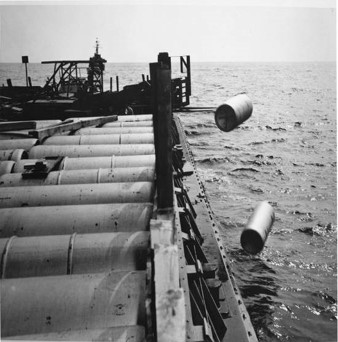
But the Allies had also captured a large amount of enemy munitions, and those had to go somewhere, too. They also decided to dispose of captured materials at sea. During Operation Davy Jones’ Locker, which ran from 1946 to 1948, the U.S. alone scuttled approximately 11 ships containing an estimated 30,000 to 40,000 tons of captured German chemical weapons.
Eventually, the environmental and safety risks became too hard to ignore, and ocean disposal was banned in 1972. The Soviet Union and the British also disposed of chemical weapons at sea, in untold numbers. Unlike Million Dollar Point, divers should probably avoid these dumping sites.
Trying to pin down the exact dollar value of all that dumped material is difficult, especially with chemical agents, because there isn’t a normal civilian market price for something like mustard gas.
Operation CHASE cost the U.S. an estimated $22 per ton, while more environmentally friendly methods cost upwards of $78 per ton for disposal. The combined tonnage of known CHASE ships was around 48,000 tons and cost $1,075,844 to sink. When adjusted for inflation, the cost of disposing of the chemical weapons in the ocean comes to $9.9 million in today’s numbers. While dumping the munitions into the sea was a huge savings, the true price tag is the weapons’ production cost, a figure we will probably never fully know.
Taken together, these examples show that throwing things into the sea has never been about simply getting rid of junk. Sometimes it was a protest against a government. Sometimes it was a shortcut for disposing of dangerous weapons. Sometimes it was an extremely calculated sales tactic.
In every case, though, the pattern is the same: huge material losses, huge financial losses, and long-term consequences that outlive the moment. The ocean became a dumping ground for political anger, military surplus, and hazardous waste, and in many places, the evidence is still sitting there.
And all of it was expensive.
Don’t Miss the Best of We Are The Mighty
• 9 Foods you didn’t know came from wartime rationing
• Operation Highjump was one of the military’s coldest missions to date
• ‘Project Jedi’ aimed to teach soldiers to use the Force when firing weapons