
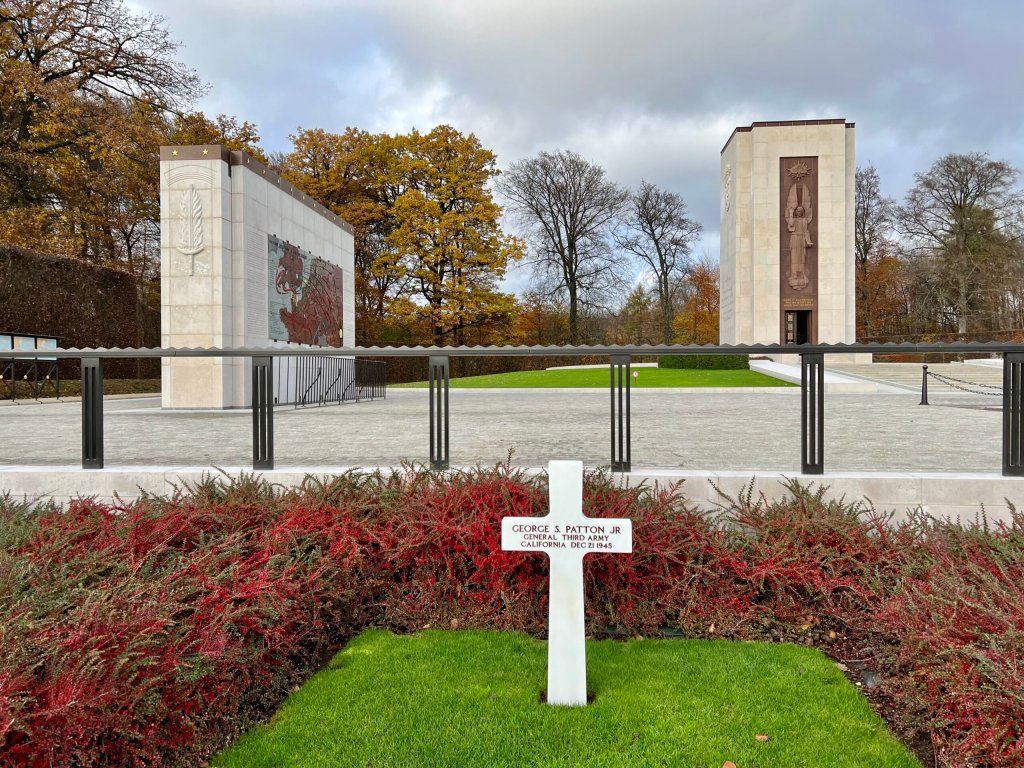
Arlington National Cemetery is the final resting place of notable World War II leaders, including Gen. Omar Bradley and Adm. William Halsey. While Maj. Gen. George S. Patton IV is buried at Arlington National Cemetery, his famous father is not. In fact, he’s not even buried in the United States.
Related: America named four tanks after General George S. Patton
After Gen. George S. Patton Jr. died in Allied-occupied Germany in 1945, his body was transported to Luxembourg and buried there. The history of Patton as a military leader is storied, to say the least.
Extensive Military Experience
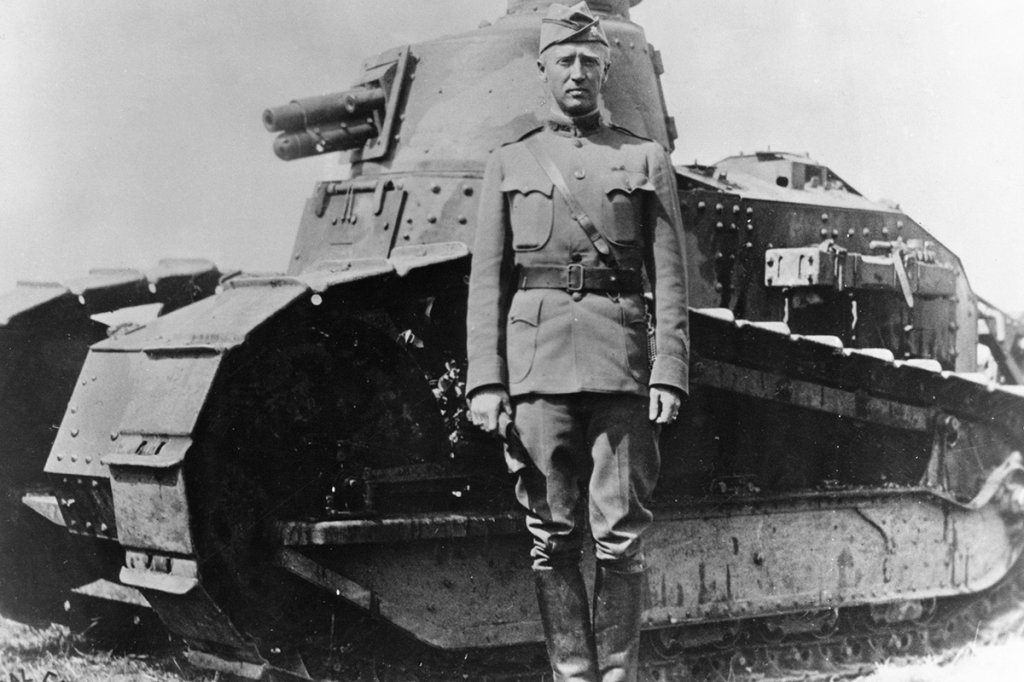
Patton first saw combat during the Pancho Villa Expedition of 1916, the first U.S. military action to use motor vehicles. During World War I, Patton became one of the first American officers to gain experience commanding tanks. He leveraged these experiences during the Second World War commanding the 2nd Armored Division and, later, the Seventh and Third Armies.
Rapid advances and aggressive offensive action characterized Patton’s command. While German adversaries feared this leadership style, it caused Patton trouble with Allied command. In Sicily, he was relieved of command of the Seventh Army after he slapped and verbally abused two soldiers suffering from combat fatigue. It was only by the intervention of Gens. Dwight D. Eisenhower and George C. Marshall, and his reputation as an aggressive combat leader, that Patton kept his stars.
Although he was sidelined for the invasion of Normandy, Patton was given command of the Third Army in 1944. Under his leadership, it cleared the Brittany Peninsula and rolled across France. On August 31, 1944, the Third Army ran out of fuel when Allied command diverted resources to Field Marshal Bernard Montgomery’s forces for Operation Market Garden. Although this allowed German troops to maintain control of Metz initially, Patton’s Third Army eventually captured the city by mid-November.
Battle of the Bulge
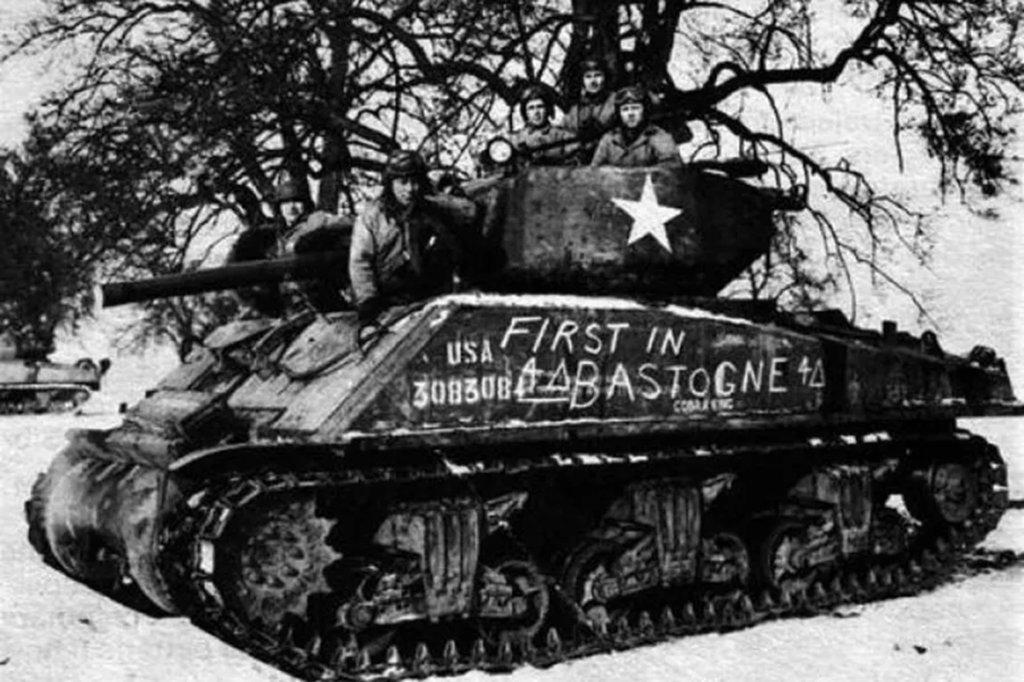
One of Patton’s most notable military actions came the next month during the Battle of the Bulge. On December 16, 1944, the Germans launched a last-ditch counteroffensive across Belgium, Luxembourg, and northeast France. Meanwhile, the Third Army was engaged in heavy fighting near Saarbrücken, Germany. At an Allied Supreme Command conference, Eisenhower asked Patton how long it would take him to disengage his Third Army’s six divisions and begin a counterattack north to break through to the encircled 101st Airborne Division.
“As soon as you’re through with me,” Patton confidently replied.
To Eisenhower’s disbelief, Patton kept his word. Thanks to a prearranged operational order, Patton began his counterattack in just 48 hours. Fighting was intense as the Third Army battled German forces in Luxembourg. But on December 26, lead elements of the Third Army’s 4th Armored Division broke through to the 101st Airborne at Bastogne. Patton later wrote that the breakthrough at Bastogne was “the most brilliant operation we have thus far performed, and it is in my opinion the outstanding achievement of the war. This is my biggest battle.”
Despite the victory, the Third Army suffered heavy casualties during the Battle of the Bulge. As a result, the Third Army’s 609th Quartermaster Company established a temporary military burial site in Hamm, Luxembourg, just outside Luxembourg City, on December 29, 1944. This was later established as the Luxembourg American Cemetery.
Patton’s Last Wish
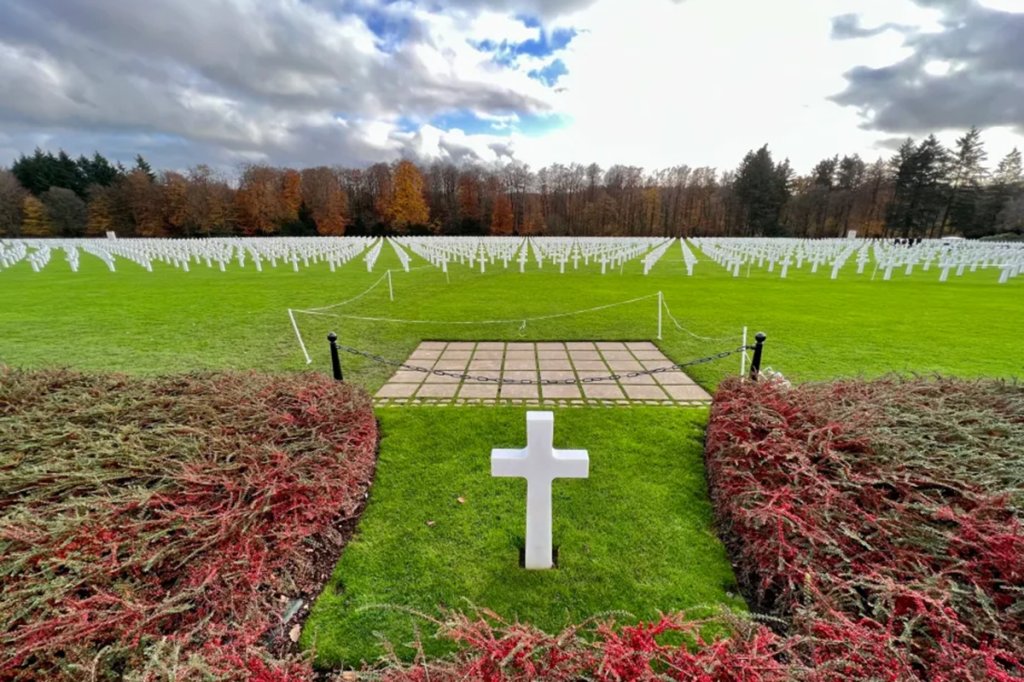
On December 9, 1945, Patton was involved in a car crash in Germany and suffered a compression fracture and dislocation of the cervical third and fourth vertebrae that resulted in a broken neck and cervical spinal-cord injury. Before he died 12 days later at the age of 60 years old, Patton made it known that his wish was to be buried with his soldiers at the Luxembourg American Cemetery.
Patton’s body was transported from Germany to the Third Army’s cemetery in Luxembourg. He was buried there in the middle of a plot, the same as his troops. It was only later, after the large number of visitors caused damage to the cemetery grounds, that Patton’s grave was moved to the front of the grave plots. His wife, Beatrice, died on September 30, 1953. She was cremated, and a portion of her ashes was scattered on her husband’s grave.
In 1951, the Grand Ducal government of Luxembourg granted the U.S. free use of the cemetery as a permanent burial ground in perpetuity without charge or taxation. Today, the Luxembourg American Cemetery and Memorial is administered by the American Battle Monuments Commission.
The cemetery is the final resting place of 5,076 American service members dead, including one female Army nurse. Additionally, two memorial pylons list the names of 371 American soldiers and airmen who remain missing in action. Inside the memorial is a chapel with a colorful mosaic ceiling. Overlooking the area where his soldiers are buried, Patton’s grave is in front of the memorial and between the two flagpoles.