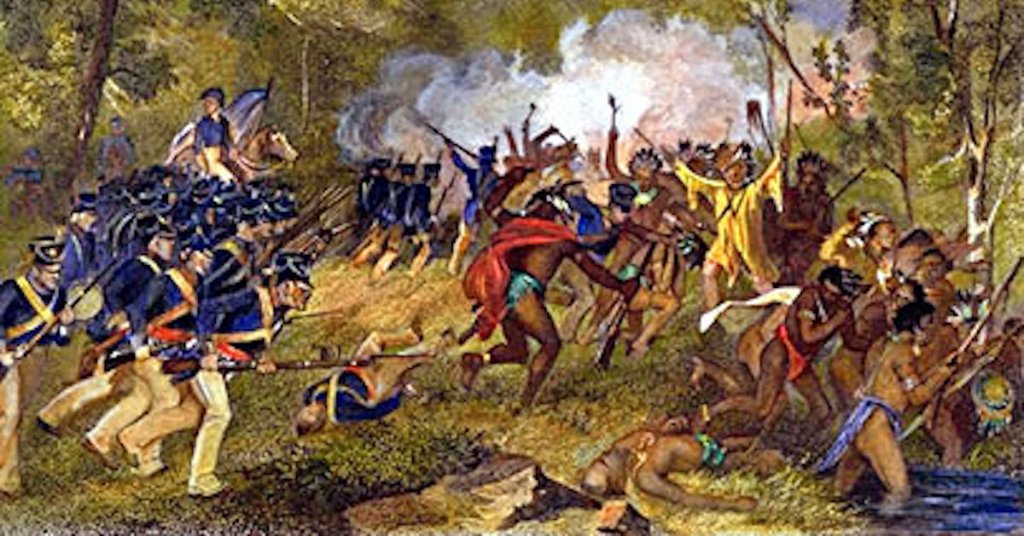
On Nov. 7, 1811, Shawnee spiritual leader Tenskwatawa was defeated at the Battle of Tippecanoe. At the time, the U.S. government was aggressively seizing frontier land from Native Americans, who began to join together to resist the foreign expansion into their territory.
Shawnee leader Tecumseh rallied a pan-tribal confederation, along with his brother Tenskwatawa—a holy man known as “the Prophet”—who founded the village of Prophetstown near the Tippecanoe River.

Battle of Tippecanoe – 11/7/1811
Born in the western Ohio Valley in 1768, Tecumseh, whose name in Shawnee means “shooting star” or “blazing comet,” grew to despise Americans after witnessing the atrocities they committed against the Native Americans and their land. He grew up honoring his people’s culture and training to be a warrior. By the 1780s, Tecumseh was participating in raids against settlers and battles against the U.S. Army. In treaty after treaty, Tecumseh watched as Native Americans were forced to cede land to the white settlers.
Prophetstown became a strategic headquarters for Tecumseh’s confederacy, and as tension and violence rose, then-Governor William Henry Harrison marched a force of 1,000 men to destroy the town.
With Tecumseh away, his brother arranged to parlay with Harrison—but instead attacked in the night. Harrison and his men repulsed the surprise force, defeated the Native American warriors, and burned Prophetstown. Tecumseh’s confederacy would never really recover.
During the War of 1812, Tecumseh joined the British to fight the United States. He urged Native Americans to unite to save their lands, cultures, and freedom from white settlement and invaders in the Northwest Territory. Tecumseh and Harrison fought in 1813 at the Thames River, where Harrison emerged victorious and Tecumseh met his unfortunate death.
The Battle of the Thames was a demoralizing loss for Indian resistance east of the Mississippi River. Many of the alliances Tecumseh created were dissolved after his death, allowing the U.S. colonizers to reestablish control of the Northwest frontier.
Don’t Miss the Best of We Are The Mighty
• 5 Native American tribes most feared by the US Army
• Why the M249 SAW still echoes in every grunt’s heart
• The 12 most badass Marine Corps nicknames of all time