
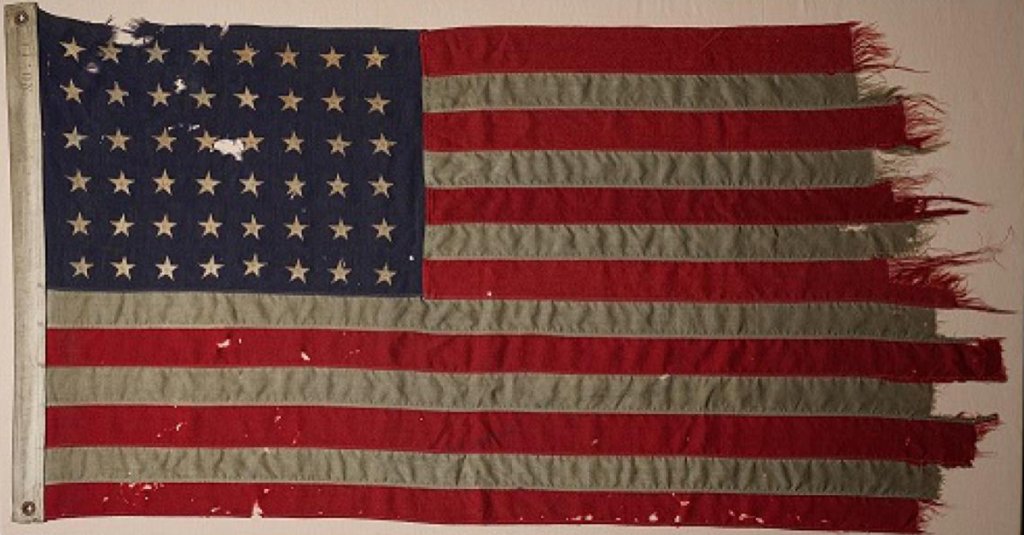
When Howard Vander Beek died in 2014 at the age of 97, he left behind a distinct reminder of his World War II service.
Vander Beek, a lieutenant (junior grade) in the United States Navy Reserve, played a pivotal role during the Normandy invasion on June 6, 1944. Vander Beek captained a crew of 13 other men on Landing Craft, Control (LCC) 60 as they guided U.S. troops onto Utah Beach on D-Day.
Also Read: How a soldier’s homemade US flag made it from a WWII POW camp to the Smithsonian
An American flag flew proudly atop LCC 60 and survived the largest military amphibious invasion ever. The treasured piece of cloth—with 48 stars on a blue background in the upper left corner, representing the number of states then—made it through the rest of the war, too.
It was tattered along the edges and had other imperfections, including a hole that a German machine gun probably caused, but Vander Beek rightly treasured it for the rest of his life. The veteran’s estate put the flag up for auction after his death, when Dutch art collector Bert Kreuk bought it in 2016 for $514,000.
“This is one of the most important historical American Flags ever to come to auction,” Kreuk wrote in an email at that time. “… Once I heard that this special flag was coming to auction, I knew I had to buy it.”
A Change of Plans
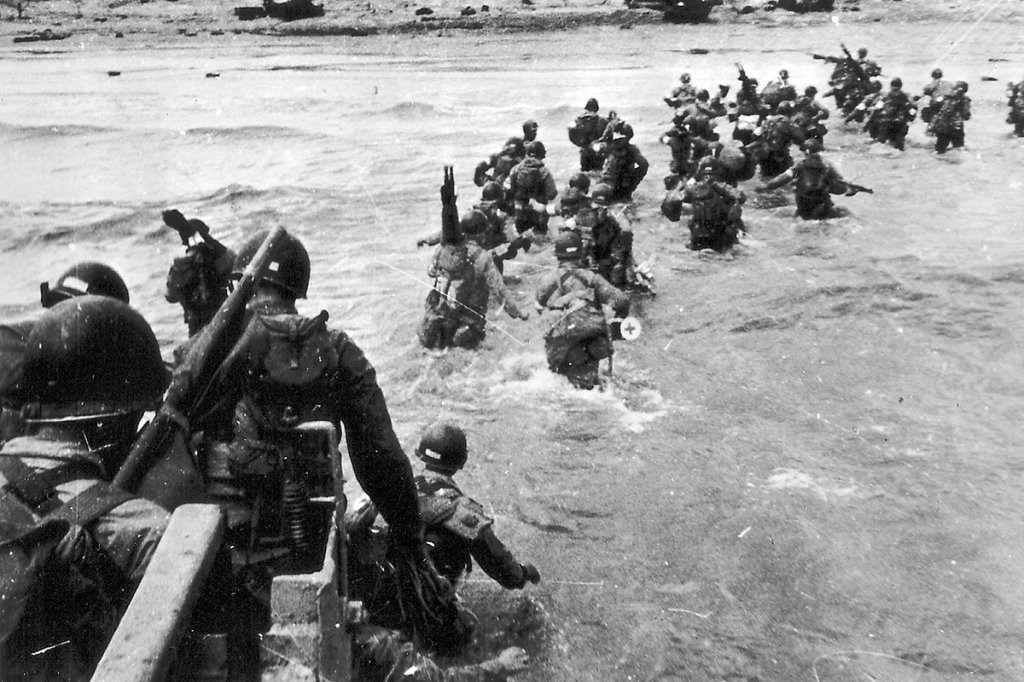
In the lead-up to D-Day, the 56-foot-long LCC 60 intended to serve as a secondary control vessel for the Tare Green sector of Utah Beach. Their level of responsibility increased shortly before the first waves of U.S. service members stormed the beach.
At 5:40 a.m., less than an hour before the troops’ scheduled arrival onshore, a sea mine took out the primary control vessel in an adjacent sector, Uncle Red, the U.S. Naval Institute reported. Then LCC 80 in that sector struck a buoy line, damaging its propeller.
With little choice, LCC 60 absorbed guiding the ships in Uncle Red onto shore while still supporting Tare Green. The gravity of the moment struck Vander Beek, a teacher from Iowa, when he turned around at sunrise to glimpse the scene behind LCC 60. There he saw “the greatest armada the world had ever known, the greatest it would ever know.”
Because of several factors, including low visibility and a strong current, the first landing craft touched shore up to 1,500 yards south of their intended target. That actually worked to the Americans’ advantage. It is not definitive how many waves of troops and supplies that LCC 60 led onto the shores of Normandy that historic day, but whatever the actual number, LCC 60 performed its mission heroically.
LCC 60 continued to direct traffic after the initial landing on D-Day until that afternoon. By the end of the invasion’s first day, the Americans sustained fewer than 200 casualties at Utah Beach.
“Finally, somehow, the day that had begun an eternity before back in England ended sometime before the sun set,” Vander Beek recalled.
Taking the Flag Home
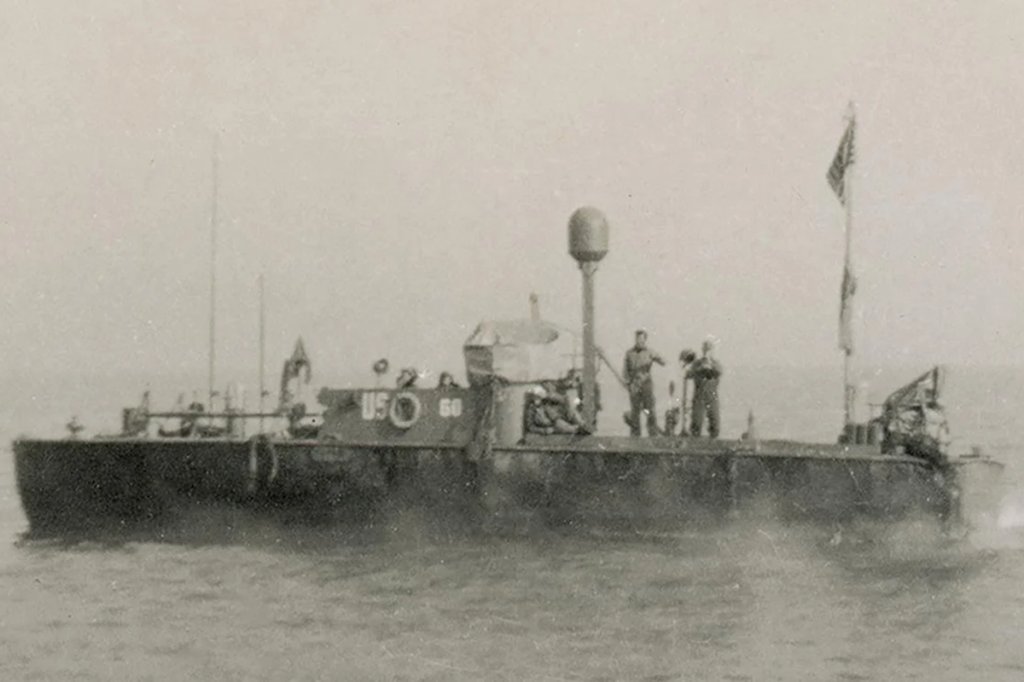
LCC 60’s service during the war didn’t end at Normandy. It also participated in Operation Dragoon, the successful Allied invasion of southern France.
When WWII concluded, Vander Beek carefully folded LCC 60’s 30-by-57-inch American flag and took it home with him. It remained in his possession for decades. When Kreuk and his uncle and business partner, Theo Schols, acquired the precious flag, it symbolized something more to him than a piece of war memorabilia.
When the Nazis invaded Kreuk’s native country in 1940, they bombed Rotterdam. A generation before Kreuk’s birth, some of his family members died in those raids. Without the success of the Normandy invasion, postwar Europe might have looked a lot differently.
Kreuk never forgot that. So when he submitted the winning bid for an American flag that flew on D-Day, he decided to return it to the U.S.
In 2019—the year marking the 75th anniversary of D-Day—Kreuk saw his opportunity. At a White House ceremony involving Dutch Prime Minister Mark Rutte, President Donald Trump accepted the flag on America’s behalf. It is now displayed in the Smithsonian Institution’s National Museum of American History.
“[It] belongs to the United States,” Kreuk said. “It’s about honoring the people who died for our freedom.”
As well as men such as Vander Beek and the rest of the LCC 60’s crew.
Don’t Miss the Best of We Are The Mighty
• Vietnam War Medal of Honor recipient Bruce ‘Snake’ Crandall dies at 93
• ‘Pressure’ is a D-Day film unlike any other before it
• Meet the dog who went from a family pet to a World War II hero
Featured

Loading comments…
Comments couldn’t be loaded. Please refresh the page.