The American experience in the Vietnam War was a long and painful one for much of the nation. For those against the war, it looked like a meat grinder for draftees, unfairly targeting the poor, the uneducated, and minorities. That is very much in dispute.
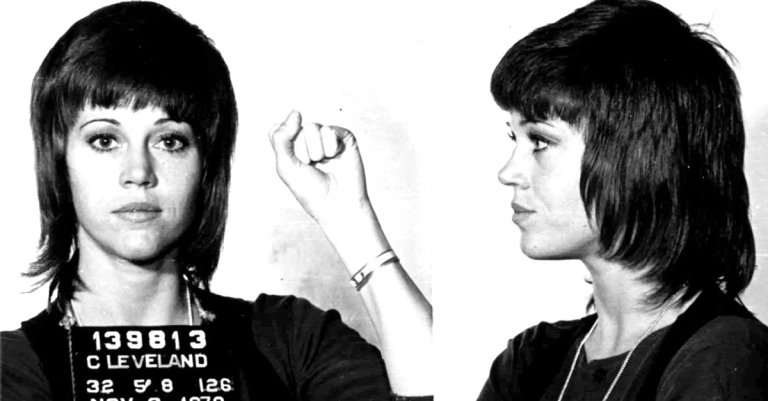
For those in favor of the war and many who served in the military at the time, the American public and media were (and still are) misled about what happened during the war, and so feel betrayed by many at home (Jane Fonda is the enduring symbol of the cultural schism).

The facts not in dispute by either side are just as harrowing: Over 20 years, more than 58,000 Americans were killed in Vietnam and more than 150,000 wounded, not to mention the emotional toll the war took on American culture. The war ended the Presidency of Lyndon Johnson and left a lasting impression on Richard Nixon’s presidency. It was the backbone to the most tumultuous period in American history since before the Civil War, one century prior.
The other facts are not so clear. We are approaching the war’s historic anniversaries, so soon, more and more government documents from that period will be declassified and released to the public for the first time. We will learn a great deal about this time in American history.
For now, however, the misinformation, cover-ups, and confusion about Vietnam still pervade our national consciousness. Right now, we can only look back at the war and take stock of what we know was real and what was BS from the start.
1. The U.S. first got involved in Vietnam in 1954.
Sort of. The official line is that the United States sent only supplies and advisors before 1965. Looking back before the fall of French Indochina, Vietnam’s colonial name, the end of World War II saw a briefly independent Democratic Republic of Vietnam under President Ho Chi Minh.
Minh even gave a nod to visiting American OSS agents by paraphrasing the Declaration of Independence in his own Independence speech: “All men are created equal. The Creator has given us certain inviolable rights, the right to life, the right to be free, and the right to achieve happiness.”
Almost as soon as Minh realized the Western allies were going to restore French rule, Chinese advisors and Soviet equipment began to flow to North Vietnamese guerrillas. After the Vietnamese Gen. Võ Nguyên Giáp handed the French their asses at Dien Bien Phu, the French left, and Vietnam would be split in two.
In 1954, an insurgency emerged, but was quelled by the government of the newly established South Vietnam, led by Ngô Dình Diem. Unfortunately, Diem was as dictatorial as Ho Chi Minh and as Catholic as the Spanish Inquisition.
2. Two presidents were shot in 1963.
They were also both Catholic, but that’s where the similarities end. This also may be the death of a coherent containment strategy in the country. Diem was shot in an armored personnel carrier on November 2, 1963. At the time, there were 16,000 U.S. advisors in Vietnam. President Kennedy was reportedly shocked by the news. Then-Secretary of Defense Robert McNamara said he “had never seen the President more upset.” Both men knew the U.S. government was responsible “to some degree.”
The Pentagon Papers leak explicitly stated that the U.S. clandestinely maintained contact with Diem over-throwers, and the U.S. government gave the generals in Vietnam the green light to start planning a coup. Twenty days later, Kennedy would himself be shot in the back of a vehicle.

3. Kennedy wanted the U.S. out of Vietnam, but couldn’t figure out how.
President Kennedy was a fervent believer in the policy of containment and believed in the Domino Theory, but not so much as to wage an unending war with the Communists in Vietnam. During his Presidency, he and McNamara actively pursued a way to leave Vietnam, while still maintaining their commitment to a free South through financial support and training. Kennedy wanted all U.S. personnel out by the end of 1965.
Many people refute this theory using a quote Kennedy gave Walter Cronkite: “These people who say we ought to withdraw from Vietnam are totally wrong, because if we withdrew from Vietnam, the communists would control… all of Southeast Asia… then India, Burma would be next.”
The only problem with this quote is that while Kennedy was in office, there was no open warfare in Vietnam, and U.S. involvement was limited. Their strategy was to bring the North to heel using strategic bombing and limited ground attacks. Recordings between Kennedy and McNamara have since been released to attest to their efforts in getting out of Vietnam.

4. The Gulf of Tonkin Incident only sort of happened.
The Gulf of Tonkin Incident is the catalyst for the escalation of American action in Vietnam. It refers to two incidents in August 1964. On August 2, the destroyer USS Maddox was shelled by NVA torpedo boats. The Maddox responded by firing over 280 rounds in return. There was no official response from the Johnson Administration.
The pressure mounted, however, with members of the military, both in and out of uniform, implying that Johnson was a coward. On August 4, the second incident was reported to have occurred, but Secretary McNamara admitted in Errol Morris’ 2003 documentary, “The Fog of War,” that the second attack never took place.
The Pentagon Papers even implied that Maddox fired first in an effort to keep the Communists a certain distance away.

The resulting Gulf of Tonkin Resolution passed by the U.S. Congress allowed Johnson to deploy conventional (read: ground) U.S. troops and operate in a state of open but undeclared war against North Vietnam.
5. The U.S. didn’t lose the war on the ground.
But the U.S. didn’t win every battle, either. The North Vietnamese Army (NVA) can’t be faulted for lack of dedication, patriotism, or leadership. Gen. Võ Nguyên Giáp orchestrated successive defeats of the Japanese and the French. Even Death had a hard time finishing off Giáp—he lived to 102.
It also can’t be faulted for a lack of organization. The NVA was a professional fighting force, organized under Soviet guidance. The VC were forced to use inferior equipment because the Chinese would swipe the good weapons and replace them with cheap Chinese knockoffs.
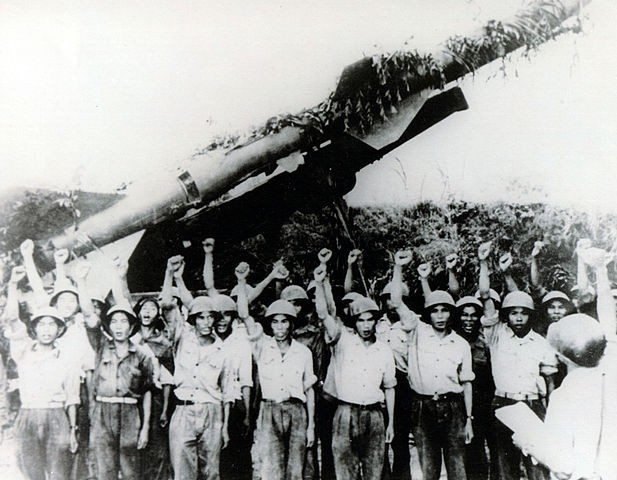
Outmanned and outgunned, the NVA was beaten by U.S. troops in nearly every major battle. The myth of the U.S. never losing a single battle inexplicably persists (unless you were stationed at Fire Support Base Ripcord, outnumbered 10-to-1 for 23 days in 1970). Although not as improbable, no U.S. unit ever surrendered in Vietnam.
Despite initial victories, the infamous Tet Offensive proved to be a significant defeat for the Communists. It resulted in the death of some 45,000 NVA troops and the decimation of Viet Cong elements in South Vietnam. The Tet Offensive succeeded on only one front: the media (more on that later). Saigon fell on April 30, 1975, two years after the Paris Peace Accords and after the American military left Vietnam. The last American troops departed in their entirety on March 29, 1973.
6. The M-16 sucked so hard, U.S. troops preferred the AK-47.
Gen. William Westmoreland, Commander of U.S. Forces in Vietnam, replaced the M-14 rifle with the new M-16 as the standard issue infantry rifle in mid-1966. There was no fanfare. The first generation of the M-16 rifle was an awful mess with a tendency to experience a “failure to extract” jam in the middle of a firefight.
They sucked so hard that the Army was hammered by Congress in 1967 for delivering such a terrible rifle system and then failing to train troops to use it properly.
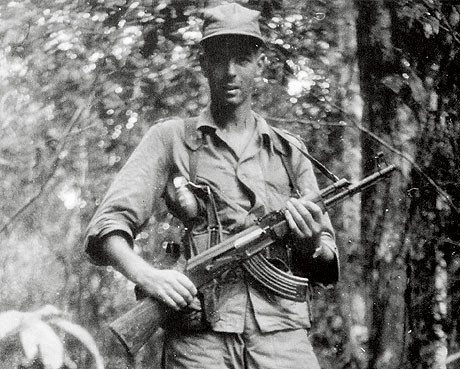
So, what to do? Pick up the enemy’s weapon. We already talked about why the AK-47 is so widely used. It’s better than dying for lack of shooting back. In Vietnam, an underground market developed among troops who didn’t trust their M-16.
“Q: Why are you carrying that rifle, Gunny?”
“A: Because it works.”
7. The ARVN—South Vietnam’s army—wasn’t all bad.
The Army of the Republic of Vietnam (ARVN) troops get mixed reviews from the Americans who fought with them—most judge ARVN units on their leadership, which was definitely mixed. In the end, the South Vietnamese ran out of fuel, ammunition, and other supplies because of a lack of support from the U.S. Congress in 1975, while the North Vietnamese were very well supplied by China and the Soviet Union.

8. The North Vietnamese Air Force was a worthy adversary.
Vietnam-era pilot and Hanoi Hilton POW was once asked on a Reddit AMA how good the NVAF fighter pilots were. His response: “They got me, didn’t they?”
This is anecdotal evidence, but more exists. The Navy’s Top Gun strike fighter tactics school was founded in response to the loss rate of one aircraft for every thousand sorties during Operation Rolling Thunder, a significant figure considering the combined 1.8 million sorties flown over Vietnam.

At war’s end, the top ace in North Vietnam had nine kills, compared to the U.S.’ top ace, who had six. The U.S. could only boast three aces (ace status requires at least five air-to-air kills), while the North Vietnamese boasted 17.
9. It wasn’t just the U.S. and South Vietnam.
Australia and New Zealand also fought in Vietnam, but the largest contingent of anti-Communist forces came from South Korea. Korean President Syngman Rhee wanted to send troops to help the South Vietnamese as early as 1954. More than 300,000 Korean troops would fight in Vietnam, inflicting more than 41,000 casualties, while massacring almost 5,000 Vietnamese civilians.

10. The draft didn’t target the working class or minorities.
The demographics of troops deployed to Vietnam closely reflected those of the U.S. at the time. 88.4% of troops deployed to Vietnam were Caucasian, 10.6% were African-American, and 1% were of other races. The 1970 census estimated the African-American population of the U.S. at 11%.
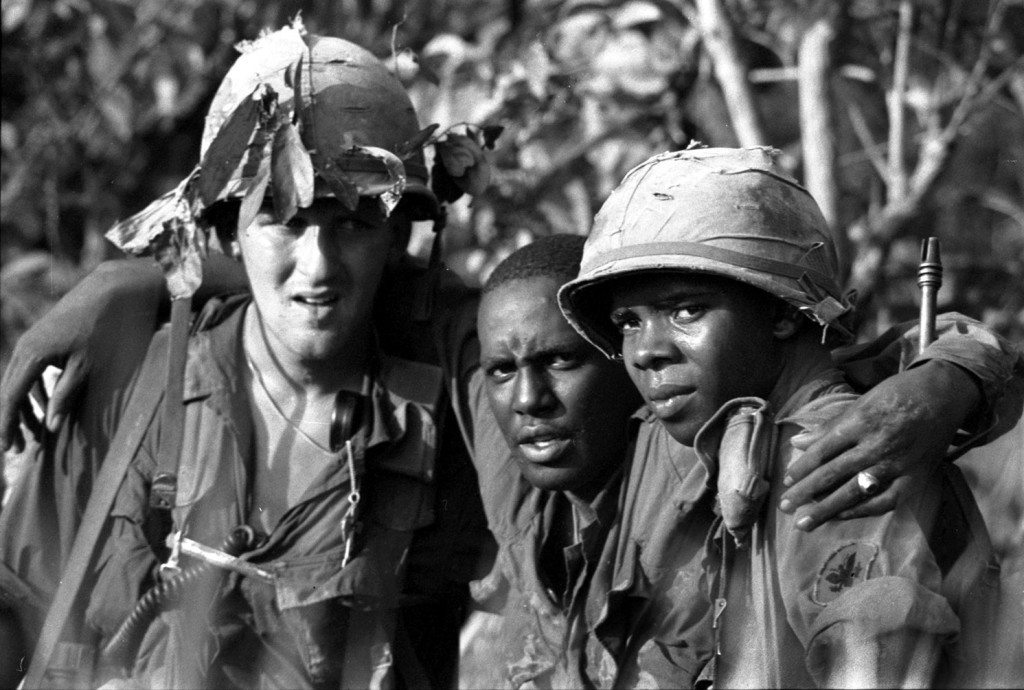
An estimated 76% of those who served there did come from working-class backgrounds, but this was a time when most troops had at least a high school education, compared with enlisted men of wars past, among whom only half held a high school diploma. Wealthier families could enroll in college for a draft deferment, but even so…
11. A majority of those who fought in Vietnam were volunteers.
More than three-quarters of the men who fought in Vietnam volunteered to join the military. Of the roughly 8.7 million troops who served in the military between 1965 and 1973, only 1.8 million were drafted. 2.7 million of those in the military fought in Vietnam at this time. Only 25% of that 2.7 million were drafted, and only 30% of the combat deaths in the war were draftees.

12. The war was not exclusively a jungle war.
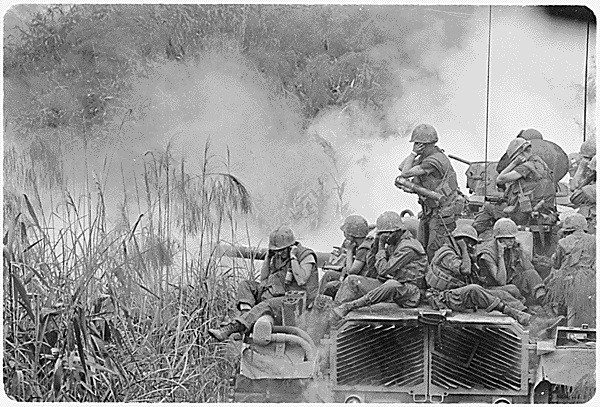
At the start, the South and allied forces were fighting Viet Cong insurgents in the jungle, but as time wore on, the battles became more set-piece, complete with tanks and artillery.
For example, in 1972, the NVA Easter Offensive was the largest land movement since the Chinese entered the Korean War by crossing the Yalu River. The Easter Offensive was a planned, coordinated three-pronged invasion of the South, consisting of 12 divisions.
13. The Vietnam War was only sort of lost in the American media.
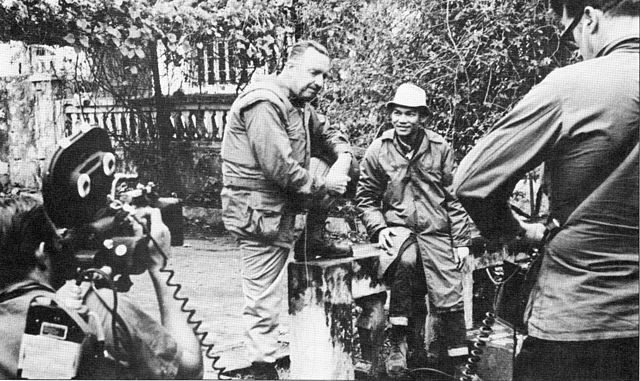
The most famous quote attributed to President Johnson (aside from “Frank, are you trying to F–k me?” and “I do not seek and will not accept the nomination of my party for another term as President”) is “If I’ve lost Walter Cronkite, I’ve lost Middle America.” Whether or not he actually said this is only important to fans of Walter Cronkite, who was then considered the most trusted man in America.
Until 1968, much of the American media was widely a mouthpiece for American policy, and not one newspaper suggested disengagement from Vietnam. But things would get worse. A 1965 Gallup poll showed only 28% of Americans were against the war, 37% in 1967, 50% in 1968, 58% in 1969. In 1971, Gallup stopped asking.
The 1968 Tet Offensive is what led Cronkite to see the war as “unwinnable.” Veterans of Vietnam widely attribute the success of the Tet Offensive as a success only in the media. The media they’re referring to is basically Walter Cronkite.

But it’s not that straightforward. A 1986 analysis of the media and Vietnam found that the reporting of the Tet Offensive actually rallied the American press to the Vietnam War effort. The Tet Offensive was a defining moment in the public’s trust in the government’s reports on the war’s progress. Americans had no idea the VC were capable of infiltrating allied installations the way they did, and many were unaware of the extent of the brutality and tactics of the war. The Tet Offensive allowed American television cameras to record the bombing of cities and the execution of prisoners of war.
The tide of public opinion shifted “for complex social and political reasons,” and the media began to reflect this shift, according to the Los Angeles Times. “In short, the media did not lead the swing in public opinion; they followed it.”
New York Times White House correspondent Tom Wicker remarked: “We had not yet been taught to question the president.” Perhaps the shift in public opinion had more to do with fatigue surrounding nearly a decade of body counts and draft lotteries.
14. Richard Nixon invaded Cambodia before ending the war.
President Nixon’s “Vietnamization” strategy involved a gradual drawdown of U.S. troops and a bolstering of ARVN forces with modern equipment, technology, and the training to use it. It also involved plans to help garner support for the Saigon government in the provinces and strengthen the government’s political position.
In 1970, he authorized incursions into Cambodia and massive bombings of Cambodia and Laos to keep pressure on the North while Vietnamization began. This prompted massive public protests in the United States. As U.S. troop numbers dwindled (69,000 in 1972), NVA attacks like the 1972 Easter Offensive showed the overall weakness of ARVN troops.

15. Vietnam Veterans are not mostly crazy, homeless, drug users.
No matter how they’re depicted on television and in movies, there is no difference in drug usage between Vietnam veterans and non-Vietnam veterans of the same age group. Some 97% of Vietnam vets hold honorable discharges, and 85% of Vietnam veterans made successful transitions to civilian life. The unemployment rate for Vietnam vets was only 4.8% in 1987, compared to the 6.2% rate for the rest of America.

16. The Communists do not still hold POW/MIAs.
Many cite “evader signals’ on satellite imagery of Vietnam as evidence of the continued imprisonment of American prisoners of war (POW). If POWs were still held in 1973, it is very likely that they are long since dead. Those hypothetical withheld POWs who did not die of old age would never be repatriated to the U.S.
The discovery of more than 600 missing individuals in Hanoi would be very difficult to explain. The fact is, North Vietnam had no reason to continue to hold American captives. The Americans would not return, and the North continued to violate the Paris Accords anyway.